
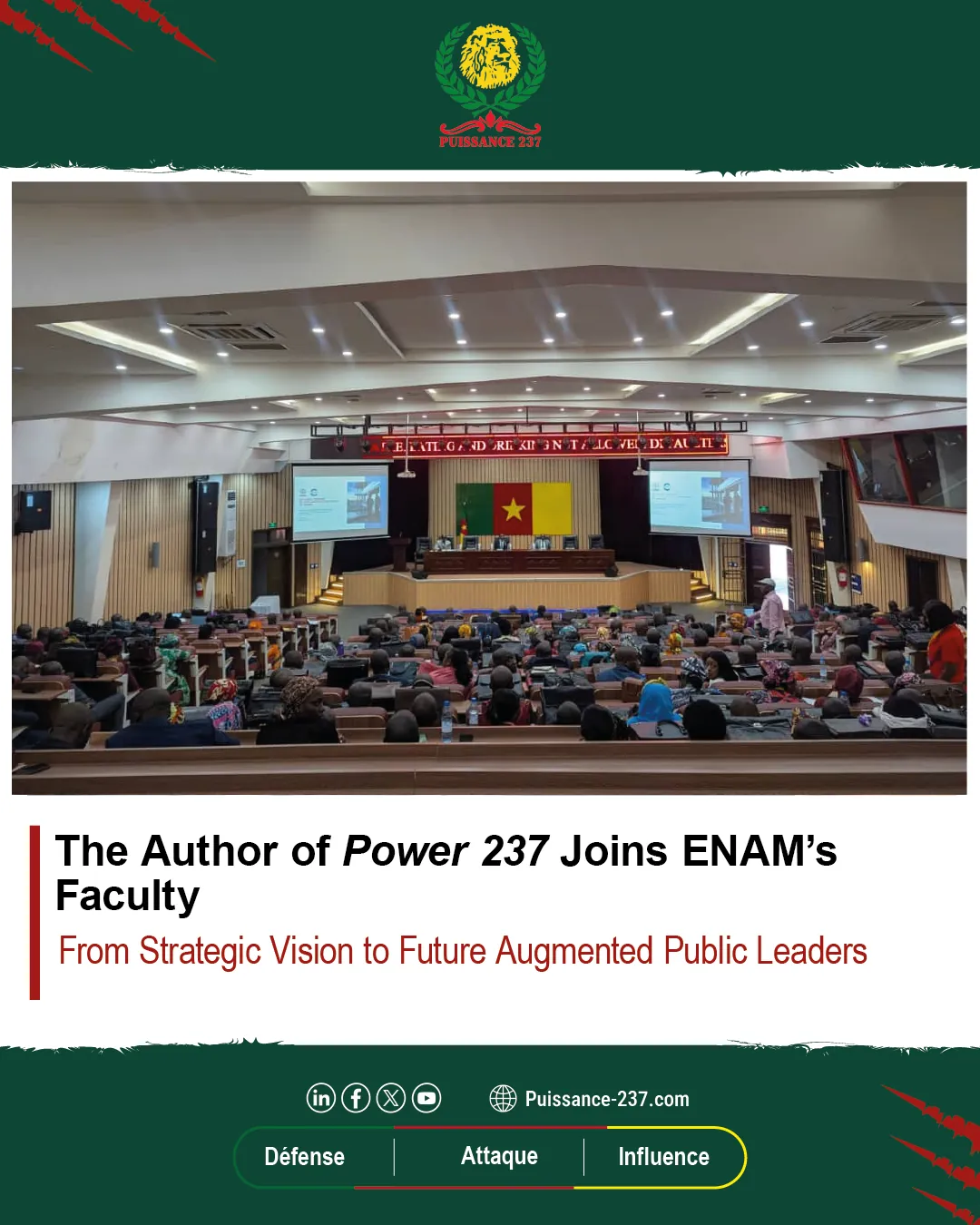
As data becomes a form of strategic memory and algorithms accelerate analysis, public decision-making is entering a new dimension. At the National School of Administration and Magistracy (ENAM), Dr Guy GWETH, author of POWER 237, is advancing this shift through augmented economic intelligence, helping prepare Cameroon’s future public-sector leaders to model change and steer the country’s strategic choices with greater confidence.
Public Administration in a Complex Environment
ENAM trains professionals destined for careers in territorial administration, diplomacy, public finance, the judiciary, oversight and public-policy management. Across all these fields, public decisions now have effects that extend well beyond their immediate administrative scope. An investment, infrastructure project, public procurement contract, regulatory reform or cooperation agreement can involve economic, technological, legal, diplomatic and, at times, security interests. It may strengthen national capabilities, but it may also create dependencies, expose sensitive information or limit the State’s ability to act in the future.
In such an environment, training cannot be limited to rules, procedures and administrative instruments. It must also prepare future public officials to understand the interests at stake, assess the reliability of partners, detect vulnerabilities and place every decision within a long-term perspective. Augmented economic intelligence responds to this need by combining human expertise with data, digital tools and artificial intelligence, thereby expanding the capacity to understand situations and make informed decisions.
From Vision to Training
InPOWER 237, Dr Guy GWETH sets out the case that Cameroon’s emergence as a regional power cannot stem solely from the abundance of its resources. It will depend on its ability to bring its institutions, infrastructure, businesses, human capital, diplomacy, culture and information capabilities into a coherent strategic framework. Power is therefore conceived as an integrated strategy in which material assets, national attractiveness, influence and control of information reinforce one another.
The arrival of the author of POWER 237 at ENAM gives that vision a practical setting: the training of public-sector elites. A power strategy is not delivered by projects, investment or government decisions alone. It also depends on the people responsible for designing, negotiating, implementing, monitoring and safeguarding those decisions. Training such officials in augmented economic intelligence means turning a long-term national ambition into working methods, analytical habits and an enhanced capacity to act.
The Augmented Public Leader
The augmented public leader is not a decision-maker replaced by machines. Rather, it is a public official whose professional judgment is strengthened by data, monitoring tools, analytical technologies and artificial intelligence. While conventional analysis depends largely on time, immediately available information and an individual’s capacity to connect it, augmented economic intelligence makes it possible to examine larger volumes of data more quickly, identify relevant connections and compare several hypotheses before a decision is made.
This expanded capability has tangible applications in public action. An administrator can better assess the consequences of a contract for local capabilities; a diplomat can more accurately decipher the interests surrounding a partnership; an inspector can evaluate vulnerabilities linked to an operator; and a magistrate can better understand the economic and information-related dimensions of a sensitive case. The augmented public leader can therefore distinguish opportunity from dependency, partnership from an unbalanced commitment, and visible information from a deeper strategic dynamic.
Anticipate, Protect and Position
The State’s areas of intervention are increasingly interconnected. An investment affects taxation, employment, technology transfer, value chains and economic sovereignty. The management of a strategic resource involves control over contracts, markets, data and external interests. Digital transformation requires the protection of critical infrastructure, public data and the country’s ability to make independent decisions. In such cases, the challenge is not simply to possess information; it is to process it early enough to inform trade-offs and prevent constraints from dictating the course of action.
Augmented economic intelligence equips future public officials with tools to map stakeholders, assess risks, analyse dependencies, monitor regulatory and technological developments, compare scenarios and secure partnerships. It strengthens their ability to anticipate, protect and position Cameroon’s interests in negotiations and in the conduct of public policy. The broader objective is to turn administrative competence into strategic capability one suited to the transformations reshaping the economy, technology and relations of power.
Dr Guy GWETH’s integration into ENAM’s faculty therefore gives POWER 237 a practical extension. By placing augmented economic intelligence at the center of training for future public-sector leaders, it helps prepare a generation able to combine human judgment, the strategic memory of data and the computing power of algorithms in the service of the State. Cameroon’s path towards regional power by 2050 will also depend on its capacity to train elites who do more than administer the present: elites able to model change, secure strategic choices and shape the future with lasting purpose.
The Editorial Staff