
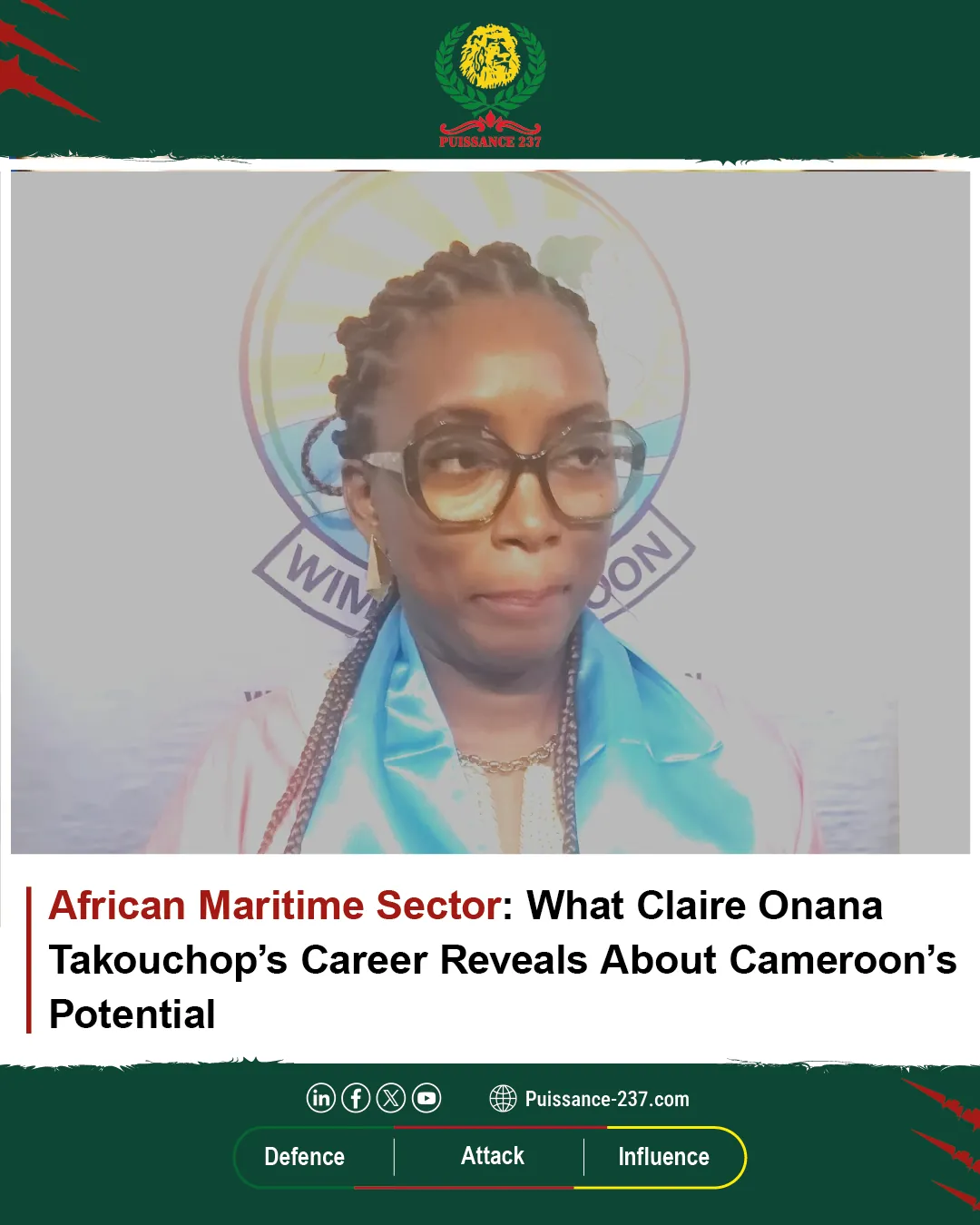
A country’s standing in a strategic sector is also reflected in the ability of its professionals to build a presence within the networks where trade, standards and cooperation take shape. Claire Onana Takouchop’s election as National President of Women in Maritime Africa (WIMA) Cameroon in January 2026 brings into focus a career built over the years in the shipping and foreign trade sector. Her career offers another way of looking at Cameroon’s presence in a field where trade, expertise and professional networks extend well beyond national borders.
A Role at the Crossroads of the Maritime Sector
The significance of her election first lies in the environment in which it took place. The new WIMA-CAMEROON executive bureau brings together women professionals from the Cameroon National Shippers’ Council (CNSC), the Port Authorities of Douala and Kribi, the Directorate General of Customs, the Single Window for Foreign Trade Operations (GUCE), the National Ports Authority and private-sector companies. In other words, one organisation brings together professionals whose respective roles provide different parts of the knowledge and operational understanding required for maritime trade.
This configuration gives particular significance to the responsibility entrusted to Claire Onana Takouchop. She stands at the intersection of stakeholders whose activities are closely connected: shippers, ports, public authorities, customs, trade facilitation institutions and private companies. Her appointment is therefore more than the presence of a Cameroonian professional at the head of an organisation. It also creates a point of connection between areas of expertise that can generate greater value when they are brought together rather than left fragmented.
Collective Intelligence as a Source of Strength
This perspective directly echoes one of the foundations developed in Power 237. The second part of the book places collective intelligence among the foundations of national power and argues that Cameroon must mobilise its human, economic and intellectual resources in support of a national project.
Claire Onana Takouchop’s career gives concrete expression to this idea. Her position at the CNSC exposes her to the realities of shippers and foreign trade, while her presidency of WIMA-CAMEROON places her at the meeting point of several components of the maritime sector. In February 2026, she also led a CNSC initiative aimed at strengthening the capacities of women engaged in cross-border trade in southern Cameroon. Expertise, in this context, does not remain tied to a single position: it moves, is shared and can help broaden the pool of stakeholders able to participate in trade networks.
Building the Skills That Will Shape the Future
This dimension is particularly important as the maritime sector already faces the challenge of renewing its skills base. In May 2026, WIMA-CAMEROON organised a conference focusing on academic pathways and professional excellence in the maritime and port sectors, before officially launching a mentoring programme for young female students. The issue therefore extends beyond immediate career development. It concerns the gradual building of a pool of skills capable of sustaining the sector over time.
This direction echoes one of the principles developed in Power 237: human resources become a lasting source of national strength when knowledge is identified, transferred and renewed rather than left as a collection of isolated skills. The challenge is therefore less about the number of professionals already available than about the country’s ability to identify talent, pass on expertise and prepare early enough those who will take on responsibility in strategic sectors tomorrow.
When Information Becomes a Strategic Asset
The maritime sector offers another perspective on this dynamic. On 21 September 2026, the CNSC and the Port Authority of Kribi continued their work on systems integration and data exchange to improve maritime flow monitoring and strengthen cooperation between the two institutions. This development highlights how the performance of a maritime ecosystem also depends on the quality of the information circulating among its various stakeholders.
Claire Onana Takouchop operates precisely within this environment, where information, support for operators, institutional cooperation and professional representation intersect. Her participation in a meeting held in Casablanca in December 2025 to present Cameroon’s economic and logistics opportunities to Moroccan operators and investors already illustrated this role. Speaking on behalf of the CNSC, she presented the opportunities offered by Cameroon’s ports and logistics corridors, placing them in the context of subregional and international trade.
A Career That Reveals a National Capacity
What this career ultimately reveals is not an individual achievement to be considered in isolation. It shows how expertise developed within a national environment can gain greater reach when it becomes part of professional networks, when experience is shared and when professionals are positioned at the intersection of several components of a strategic sector.
This is where the perspective developed in Power 237 takes on its full meaning: having resources is not enough. A country must also be able to identify them, connect them and mobilise them. Claire Onana Takouchop’s career provides a concrete illustration of this challenge in the maritime sector. Above all, it invites a different way of looking at Cameroon’s potential: not only through what the country possesses, but through what it is able to do with its expertise when that expertise begins to carry weight beyond the national level.
The Editorial Staff