
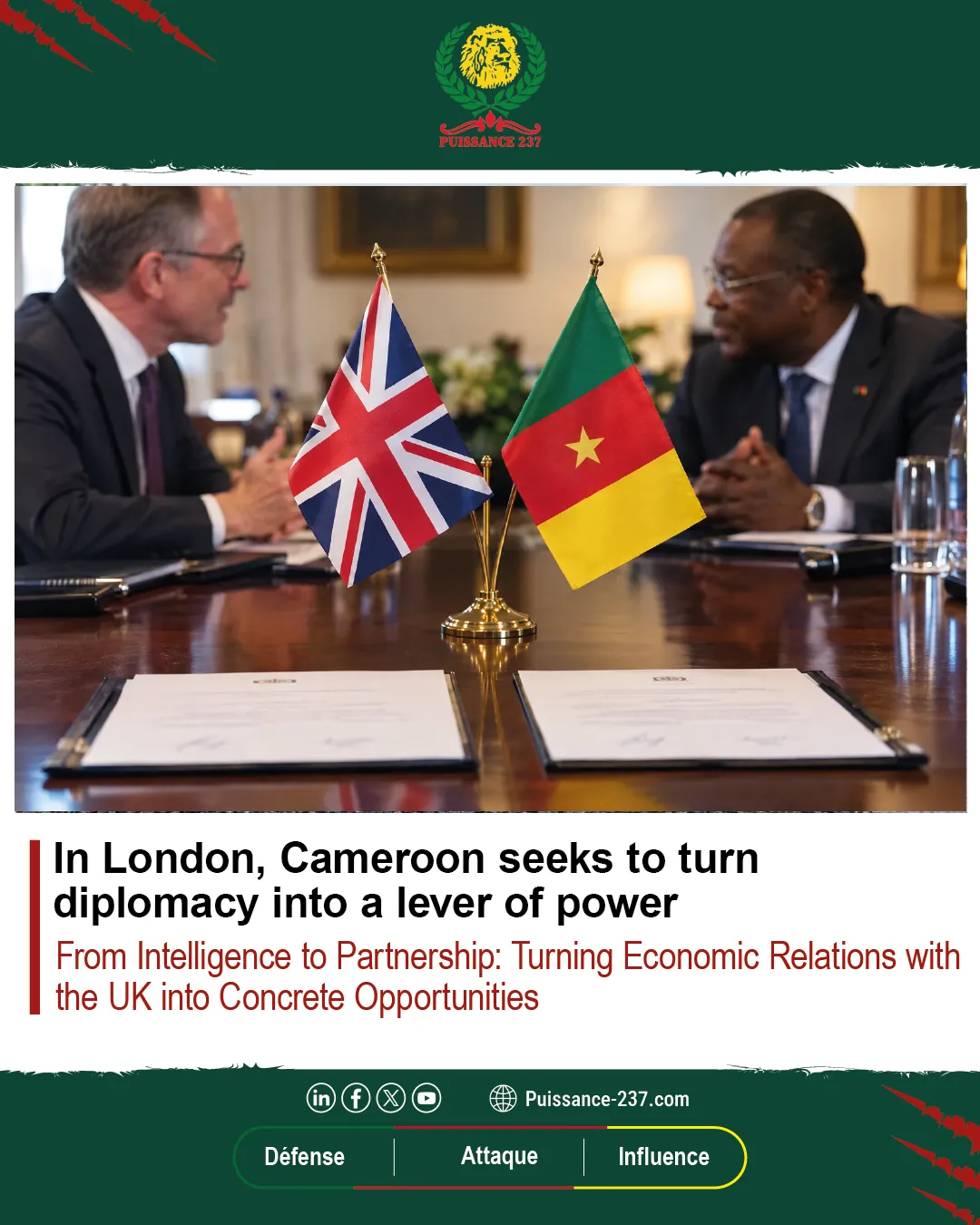
After a 32% decline in trade with the United Kingdom, Cameroon is preparing an economic mission to London in December 2026 to attract capital, technology and strategic partnerships. This new economic push comes as the country seeks to strengthen its presence in the British market. It also provides a concrete opportunity to put the principles of economic diplomacy advocated in Power 237 to the test.
Revitalizing an Economic Relationship
Trade between Cameroon and the United Kingdom stood at £242 million in the 12 months to March 2026, down 32% year-on-year. Over the same period, British foreign direct investment stock in Cameroon stood at £98 million at the end of 2024.
The December mission is intended to attract new financing and partnerships, particularly in energy, infrastructure, agriculture, agro-industry and consumer goods, with a focus on investment, technology transfer and local value creation.
Diplomacy as a Lever of Power
In Power 237, Dr. Guy GWETH puts forward a strategic vision aimed at equipping Cameroon with a pathway towards regional power. The book is built around three dimensions: defense, offence and influence and calls for greater coordination of the country’s economic, diplomatic, technological and informational resources.
Applied to London, this approach gives economic diplomacy a role that goes beyond representation. It means understanding the interests at stake, defending Cameroon’s interests, identifying opportunities and engaging partners capable of contributing to clearly defined objectives. The mission thus becomes an exercise in targeting and negotiation.
Intelligence Before Negotiation
This approach begins with a thorough understanding of the market. Targeted intelligence should identify British companies likely to invest in Cameroon, importers and distributors worth approaching, market needs, regulatory developments and technologies aligned with national priorities.
As President of the African Center for Competitive Intelligence (CAVIE), Dr. Guy GWETH has consistently emphasized the role of competitive intelligence in producing and using information for decision-making. For the London mission, this preparation should help distinguish promising contacts from partners with the actual capacity and willingness to commit.
Targeting the Right Partnerships
The search for capital should not be separated from the search for capabilities. A British partner can bring financing, but also technology, expertise, commercial networks or industrial know-how. The targeting process should therefore start with Cameroon’s needs and the capabilities required to address them.
This approach echoes the offensive dimension of Power 237: identifying opportunities and building the means to seize them. For the British mission, this means presenting sufficiently mature projects to support negotiations on financing, market access, local production, skills development and technology transfer.
Turning Partnerships into National Capabilities
The objective is also to ensure that partnerships strengthen domestic capabilities. In energy, agro-industry, infrastructure and digital technologies, skills development, local suppliers, maintenance capacity and access to know-how can matter as much as the amount of capital invested.
Economic partnerships should therefore contribute to building Cameroon’s own capabilities. International cooperation can then become a means of progressively strengthening the country’s technological, industrial and commercial capacity rather than simply a source of foreign capital.
Turning Influence into Results
The London mission could ultimately serve as a concrete test of the strategic doctrine advanced in Power 237. Its impact will not be measured by the number of meetings held, but by the ability to prepare targets, qualify projects, negotiate interests and follow through on commitments.
For Cameroon, the challenge is ultimately to turn information into decisions, decisions into partnerships, and partnerships into lasting capabilities. It is this continuity between competitive intelligence, diplomacy, the pursuit of opportunities and influence that can give the British mission a genuine strategic dimension.
The Editorial Staff