
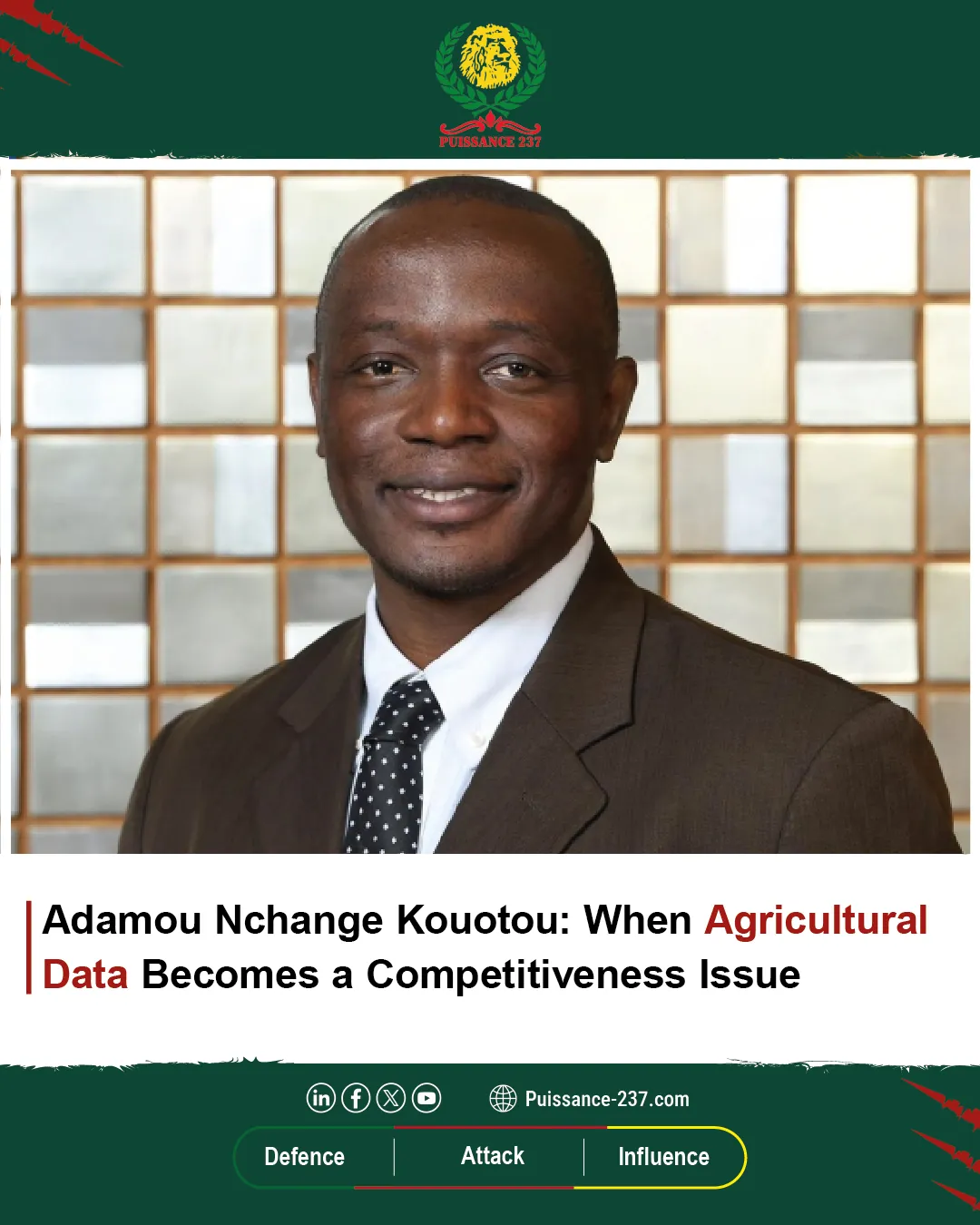
Cameroon has significant agricultural potential, but resources alone do not create a competitive advantage. Between the farm and the market lie crop knowledge, access to finance, risk management, productivity, infrastructure, processing and access to information. Adamou Nchange Kouotou’s trajectory offers a useful perspective on one of the key intersections in this equation: the point at which technological skills are applied to understanding and financing agricultural production.
From an Agricultural Challenge to an Information Issue
Kouotou’s experience in technology and telecommunications was the starting point for a reflection born out of a practical challenge. When he considered entering agriculture himself in 2016, he realized that his limited agricultural knowledge could be a barrier to his project. He therefore chose to use his expertise as a computer engineer to address this challenge, not only for himself but also for smallholder farmers facing similar difficulties. Agrix Tech was established in 2018 around this approach.
The initial challenge appears agricultural: identifying a disease, determining a treatment and limiting losses. But once the information collected makes it possible to better characterize a farm, the issue takes on a different dimension. Data on crops, plots and risks can also help assess the viability of a project, determine its level of risk or inform a financing decision. Agrix Tech has progressively positioned itself at this intersection between agricultural information and financial decision-making, notably through machine learning and satellite data. Data can therefore make a farm more legible to those responsible for financing or insuring it, gradually transforming technical information into an economic decision-making tool.
When Information Becomes a Competitive Advantage
This evolution changes the role of data within the agricultural value chain. Information about a plot can serve the farmer, but it can also be relevant to a bank, an insurer, an input supplier or a market operator. Its value therefore depends not simply on its existence, but on the ability to collect, structure and interpret it in ways that reduce uncertainty or improve decision-making.
Agricultural competitiveness does not depend solely on the ability to produce more. It also depends on the ability to make production sufficiently visible and measurable to mobilize capital, assess risks and reach markets. When information improves decision-making, it becomes part of the productive system itself. The strategic issue is therefore to determine who produces this information, who controls it and who can turn it into an economic advantage.
Human Capital as a Strategic Capability
Kouotou’s trajectory illustrates this ability to connect different fields. His background in technology and his experience in digital infrastructure and financial services enabled him to transfer these skills to an agricultural challenge. His trajectory highlights the value of profiles capable of moving across sectors and turning technological expertise into solutions addressing productive needs.
Within the Power 237 framework, this type of trajectory takes on a broader significance: human capital becomes a source of national power when it can be connected to strategic sectors and transformed into productive capabilities. The issue therefore extends beyond the success of an individual company. It concerns a country’s ability to develop talent capable of creating, adapting and exporting solutions that address both domestic needs and those of other African markets.
From Cameroonian Innovation to African Capability
Agrix Tech had already considered expanding into Ghana, Senegal and other African markets. This ambition illustrates what can happen when an innovation moves beyond its original national context: a solution developed in response to a Cameroonian constraint can potentially become a capability that can be deployed and commercialized across several markets.
For Cameroon, the issue is therefore less about counting its innovations than identifying those capable of scaling, creating lasting capabilities and enabling more value to be retained within production chains. This reading echoes one of the underlying concerns of Power 237, the strategic project led by Dr Guy Gweth: transforming human capital, innovation and control over information into capabilities that can strengthen Cameroon’s position in its regional environment. Kouotou’s trajectory thus highlights a broader reality: agricultural resources become a genuine competitive advantage only when an ecosystem can understand them, finance them, develop their value and, above all, master the tools required to capture more of the value they generate.
The Editorial Team