
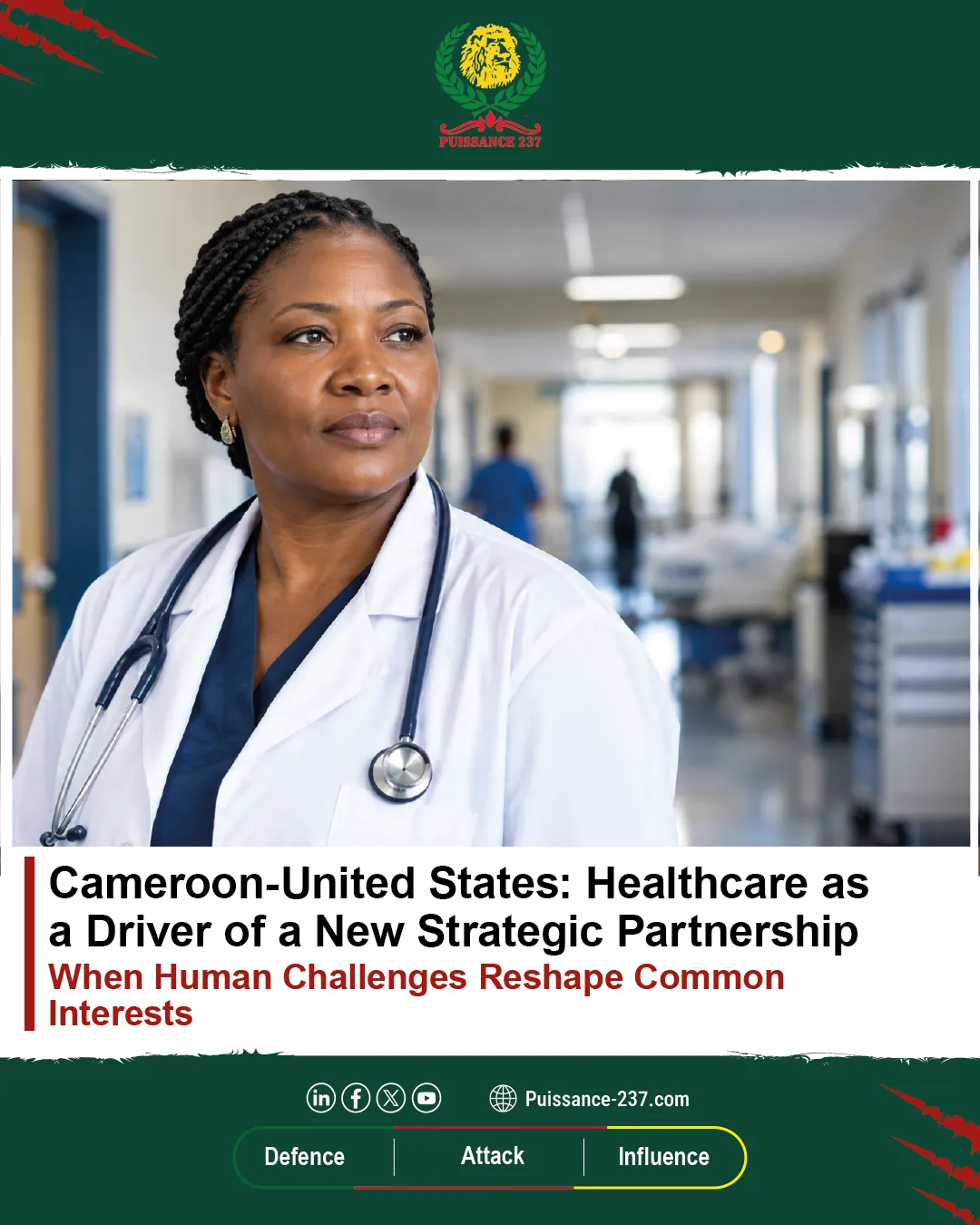
Cameroon is consolidating its place in the new healthcare cooperation framework that the United States is developing across Africa. The participation of the Minister of Public Health, Malachie Manaouda, in a high-level meeting held in New York on September 21 opens a new chapter in a bilateral partnership already underway between Yaoundé and Washington.
A Consolidating Cooperation Framework
Cameroon was one of seven African countries invited to the meeting, held to mark the first anniversary of the United States’ “America First” global health strategy. It was represented alongside Tanzania, Uganda, Nigeria, Kenya, Mozambique and Ethiopia, as well as US officials involved in the initiative.
The health partnership between Yaoundé and Washington is based on a memorandum of understanding signed in December 2025. Its implementation plan was approved in July 2026, and performance indicators were jointly reviewed. On September 19, the two sides signed a Strategic Objective Agreement (SOAG), designed to strengthen the operational and financial framework of this cooperation.
Funding Tied to National Commitments
The agreement mobilizes approximately $850 million over five years. The United States is expected to provide $400 million, while Cameroon plans to contribute $450 million through co-investment. This funding structure places Cameroon in a position different from that of a simple recipient: the state is expected to commit its own resources, set priorities and demonstrate the results of the cooperation.
The planned establishment of a Program and Transition Management Unit is intended to support the implementation of the partnership and prepare for its continuity beyond 2030. Its ability to track funding, coordinate institutions, measure results and strengthen national capabilities will be critical to the long-term sustainability of the initiatives undertaken.
A Health Diplomacy Challenge
This sequence illustrates the growing importance of health diplomacy in relations between African states and international partners. Health is becoming a space for negotiation where access to funding, service delivery systems, health data, medical supplies, workforce training and health security intersect.
From this perspective, the strategy developed in Power 237, authored by Dr Guy Gweth, President of the African Center for Competitive Intelligence (CAVIE), takes on particular significance. The book calls on Cameroon to mobilize its international partnerships in support of national priorities, strengthen its negotiating capacity, protect its decision-making autonomy and turn external support into lasting capabilities.
Turning Cooperation into National Capacity
The defence dimension requires Cameroon to retain control over its health priorities, data, indicators and the use of its co-investment. It also involves reducing dependencies that may persist after funding ends: external expertise, equipment that cannot be properly maintained, imported inputs, digital tools that are not mastered locally, or parallel mechanisms operating outside national institutions.
The offensive dimension refers to the active use of the partnership to accelerate the strengthening of the health system: professional development of teams, modernization of laboratories, improvement of supply chains, development of information systems and enhanced capabilities within institutions responsible for steering the sector. The influence dimension will ultimately depend on Cameroon’s ability to produce demonstrable results, share its experience with other African partners and strengthen its credibility in regional discussions on health financing and governance.
Implementation as a Strategic Challenge
The partnership with the United States provides Cameroon with a significant financial and diplomatic lever. Its impact will nevertheless depend on how commitments are translated into accessible services, sustainable skills, effective institutions and financing mechanisms capable of supporting national priorities beyond 2030.
In the logic of Power 237, the challenge is not simply to secure or manage funding. It is to turn health cooperation into an instrument of sovereignty, institutional strengthening and continental influence.
The Editorial Staff