
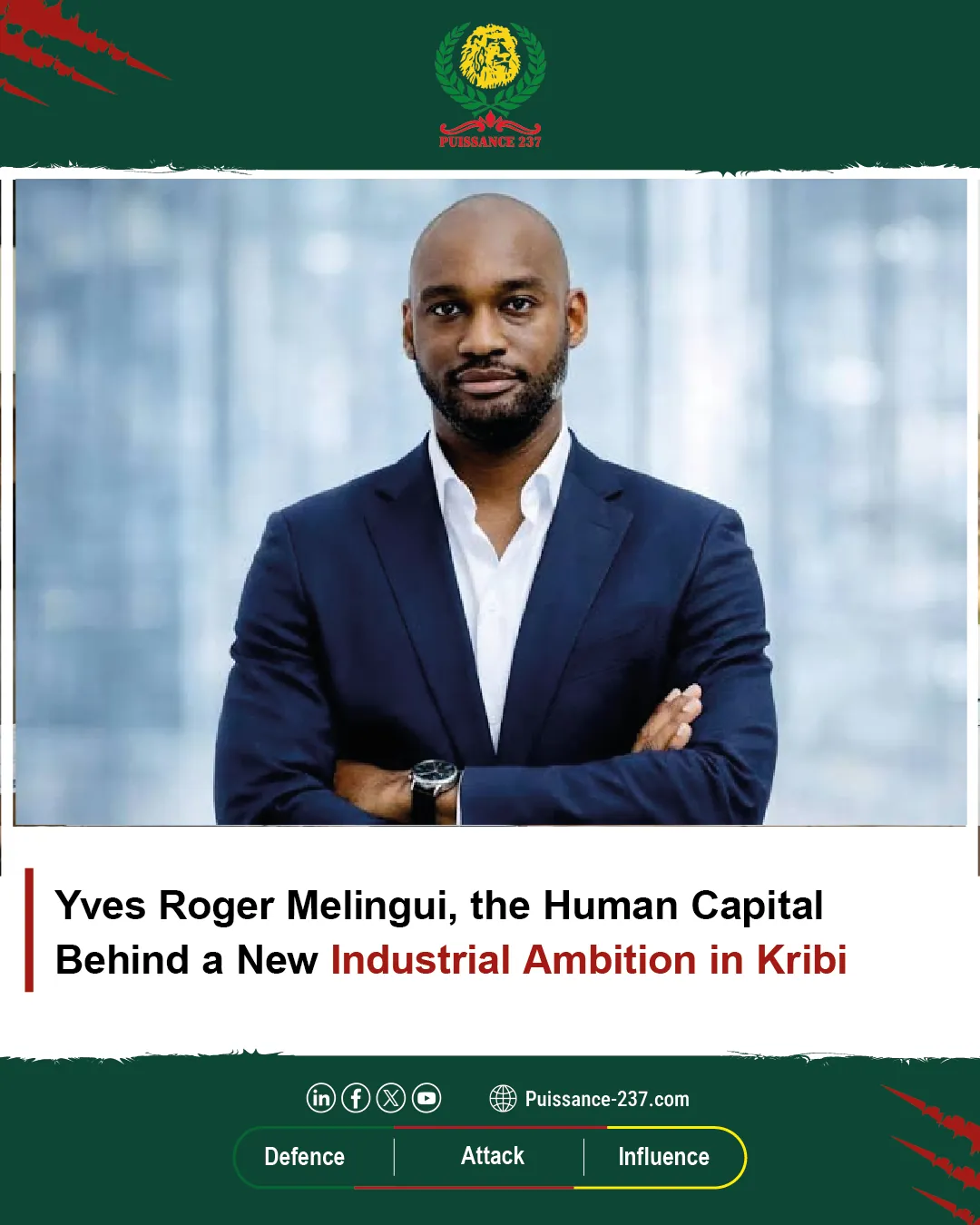
Identifying talent also means understanding the strategic moment in which that talent comes into play. Yves Roger Melingui, the first Managing Director of the Kribi Port Industrial Zone (KPIZ), stands at a turning point for Cameroon: the point at which Kribi’s port advantage must now be converted into industrial capacity, value creation and greater regional economic influence. It is this interplay between expertise, infrastructure and national ambition that places his career on the talent map followed by Power237.
A responsibility that extends beyond an industrial zone
KPIZ is not simply an extension of the port. Established in February 2026 by the Kribi Port Authority in partnership with Africa Global Logistics, Arise Integrated Industrial Platforms and Belmont Investments, it is expected to develop and operate approximately 4,000 hectares of industrial land directly connected to the port. The announced investment amounts to €795 million. The project notably targets the timber and logistics, steel, petrochemical, agribusiness and construction materials sectors.
Melingui’s appointment therefore takes on a broader significance. His experience in finance, strategy and public-private partnerships comes into play in a project where the challenge is not simply to attract investors, but to create the conditions for them to process locally, make use of Cameroonian infrastructure and integrate into broader value chains. In an interview published in June 2026, the executive identified the combination of the deep-water port and its industrial land, together with the ambition to offer investors an integrated environment, among the zone’s key strengths.
The real challenge: capturing more value
This is where the power dimension comes into focus. A port can facilitate the transit of goods; an industrial-port platform can make it possible to process part of those goods, attract capital, create skilled jobs and develop local suppliers. The difference between these two functions determines, in part, how much value Cameroon retains or allows to leave through global value chains.
Projections announced at the launch of KPIZ point to as many as 150,000 direct and indirect jobs over fifteen years and a potential increase of five to eight percentage points in economic growth. These figures remain projections, but they illustrate the scale of the transformation being pursued. For Power237, the significance of this profile lies precisely in this perspective: Kribi’s real asset is not only its port, but Cameroon’s ability to build a competitive industrial ecosystem around it.
A talent profile within the map of national power
It is this ability to connect infrastructure, investment, industry, competitiveness and regional influence that underpins Power237’s decision to highlight Yves Roger Melingui, an initiative dedicated to identifying, showcasing and connecting Cameroonian talent, led by the African Center for Competitive Intelligence (CAVIE) under the direction of Dr Guy Gweth. The profile is not presented solely because of the position he holds, but because that position provides a window into a critical area of Cameroon’s economic transformation.
Looking towards 2035-2050, the question will be whether the country’s strategic infrastructure can become genuine platforms of power. Kribi is one of the places where this ambition is taking concrete shape: attracting, processing, connecting and exporting more from Cameroon. Melingui’s role lies at the heart of this equation.
The Editorial Staff