
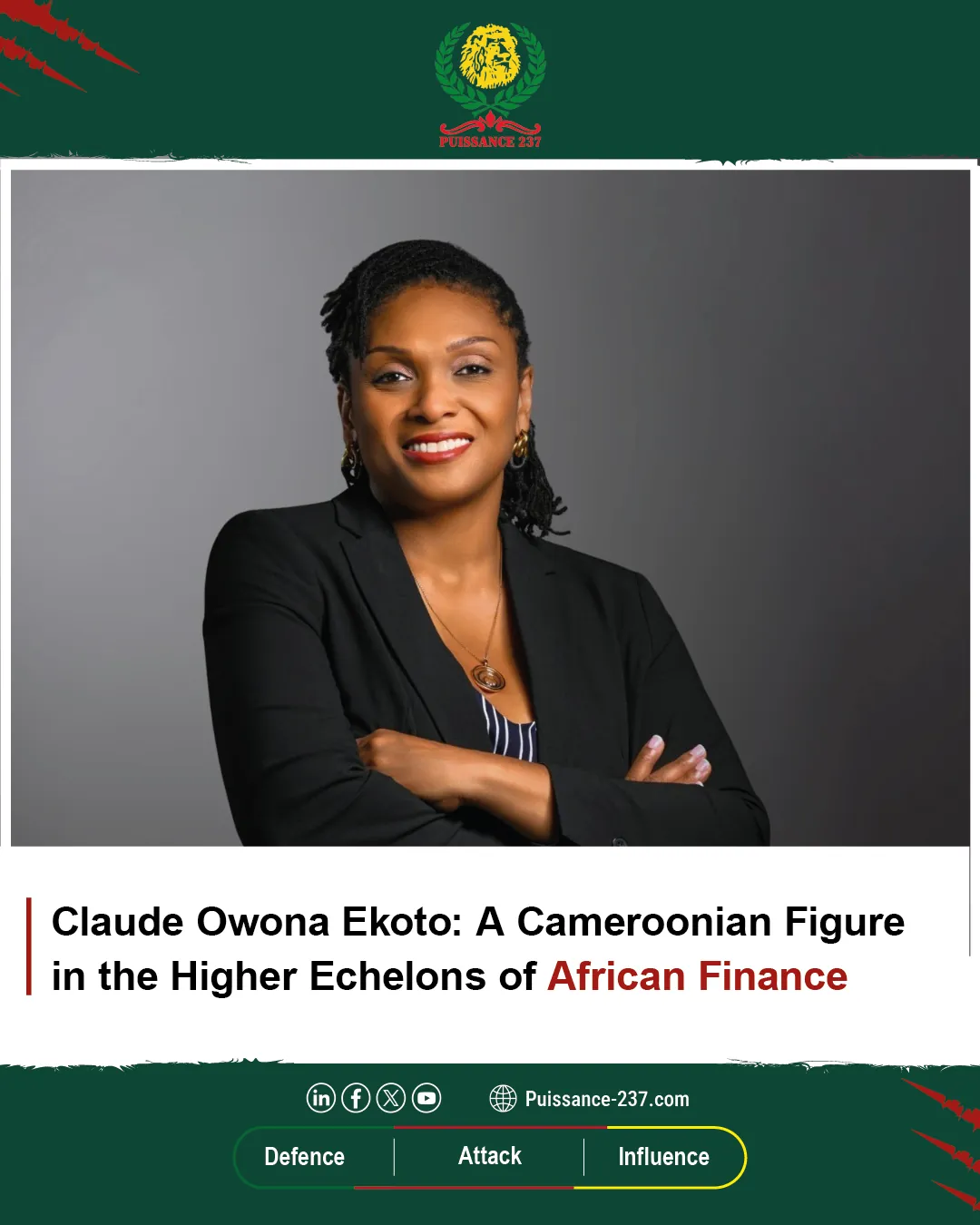
In its mapping of the people whose achievements can contribute to Cameroon’s rise as a power, Power 237 looks beyond individual success stories to identify positions, expertise and networks with broader strategic significance. Claude Owona Ekoto stands out in this regard. Since July 2026, the Cameroonian banker has served as Regional Industry Manager for the Financial Institutions Group at the International Finance Corporation (IFC), covering Central Africa and Anglophone West Africa. From this position, she works with financial institutions and partners to expand access to finance for businesses, farmers and entrepreneurs across the region.
A Career Built Across the Financial Sector
Claude Owona Ekoto’s profile reflects more than two decades of experience spanning treasury management, commercial and retail banking, and development finance. Her career has included senior positions at international banking groups such as HSBC and Société Générale, where she served as Deputy CEO of Société Générale Burkina Faso. She later joined the IFC as a Senior Investment Officer, working across both developed and emerging markets, including Canada, France, Hong Kong, the United Kingdom, the United States, Cameroon, India and West Africa.
This combination of commercial banking and development finance has placed her close to one of the central questions facing African economies: how to channel capital towards businesses capable of creating jobs, expanding production and strengthening local value chains. Her experience has particularly focused on financial institutions and on expanding financing for micro, small and medium-sized enterprises, women entrepreneurs and agricultural value chains.
Where Finance Meets Productive Capacity
The significance of this work becomes clearer when viewed from the perspective of business growth. Access to capital does not automatically translate into stronger companies. Businesses need financing adapted to their stage of development, reliable information, appropriate risk assessment and financial institutions capable of supporting their expansion.
This is where financial intermediation becomes a component of economic competitiveness. When financing reaches an agricultural value chain, for example, it can support production, processing, equipment and distribution. When it reaches an SME, it can help the company invest, recruit, increase output or enter a new market. The financial system therefore has a direct bearing on the capacity of businesses to move from potential to scale.
Claude Owona Ekoto’s work at the IFC has been closely connected to this challenge. The institution says that, in her new regional role, she will work with financial institutions and partners to expand access to finance for businesses, farmers and entrepreneurs driving growth and job creation.
Information, Risk and Access to Capital
Behind every financing decision lies another strategic resource: information. A lender must be able to understand a company’s activity, assess its risks, identify its prospects and determine how financing can support its development. The quality and availability of information therefore influence how economic opportunities are perceived and financed.
This becomes particularly important for businesses and entrepreneurs with limited banking histories. Alternative data, digital transactions and other economic signals can provide additional information for assessing creditworthiness. Better information can help financial institutions identify viable businesses that might otherwise remain outside conventional financing channels.
The issue therefore extends beyond banking. It touches on how economic information circulates, how risk is qualified and how opportunities become visible to investors and financial institutions. In economies where access to finance remains a constraint for many businesses, these mechanisms can have consequences for productive capacity and market expansion.
From Business Finance to African Growth
Claude Owona Ekoto’s new mandate covers two major African economic regions. Her responsibilities come at a time when expanding financing for SMEs, entrepreneurs and underserved segments remains a major development challenge.
The IFC has identified financial institutions as an important channel for reaching businesses at scale. Through banks and other financial intermediaries, it can support lending to SMEs and other segments of the economy while combining investment, risk-sharing and advisory instruments. The objective is not simply to place capital in the market, but to strengthen the financial channels through which capital reaches productive activities.
For Central Africa, this question has particular relevance. Companies seeking to expand across borders need access to capital, but they also need the capacity to manage risk, structure their operations and respond to new market opportunities. In the context of the African Continental Free Trade Area (AfCFTA), the connection becomes even more significant: broader market access creates opportunities, but businesses must have the financial and productive capacity to seize them.
The sequence is therefore straightforward: information helps qualify opportunity and risk; finance makes investment possible; investment strengthens productive capacity; and productive capacity allows businesses to compete in larger markets.
A Cameroonian Presence in a Strategic Financial Space
Claude Owona Ekoto’s position also offers a different way of looking at Cameroon’s presence in Africa’s economic networks. Her career has taken her from Cameroon into international banking and development finance, while her current responsibilities place her within a regional platform connecting financial institutions across Central Africa and Anglophone West Africa.
For Power 237, the interest of such a profile lies precisely in this intersection between individual achievement and national capacity. A professional operating at this level carries knowledge of financial markets, institutions, investment mechanisms and business environments across several African economies. These connections form part of the less visible infrastructure through which capital, expertise, information and opportunities circulate.
Her trajectory also illustrates the importance of positions that connect Cameroon to wider African economic networks. National power is not measured only through physical assets or financial volumes. It can also be observed through the presence of nationals in institutions and networks where major economic flows are structured, financed and connected.
Mapping the Capabilities That Can Shape Cameroon’s Future
Claude Owona Ekoto is therefore more than a profile in banking. Her career provides an entry point into a broader question for Cameroon: where are the people, institutions and networks through which the country can participate in Africa’s economic transformation?
This is the purpose of the Power 237 mapping exercise: to identify women, men and projects whose achievements reveal concrete capabilities across the country and beyond its borders. Finance is one of these strategic fields, alongside industry, energy, agriculture, healthcare, technology, infrastructure and the green economy.
The challenge is to connect these capabilities, understand where they are positioned and examine how they can contribute to Cameroon’s projection as an African power between 2035 and 2050. Claude Owona Ekoto’s trajectory offers one such point of reference: a Cameroonian career positioned within the financial mechanisms that help determine how businesses grow, how capital moves and how African economies build their productive capacity.
The Editorial Team