Cameroonian ebony: The strategic challenge of capturing more value from the value chain
16 October 2026
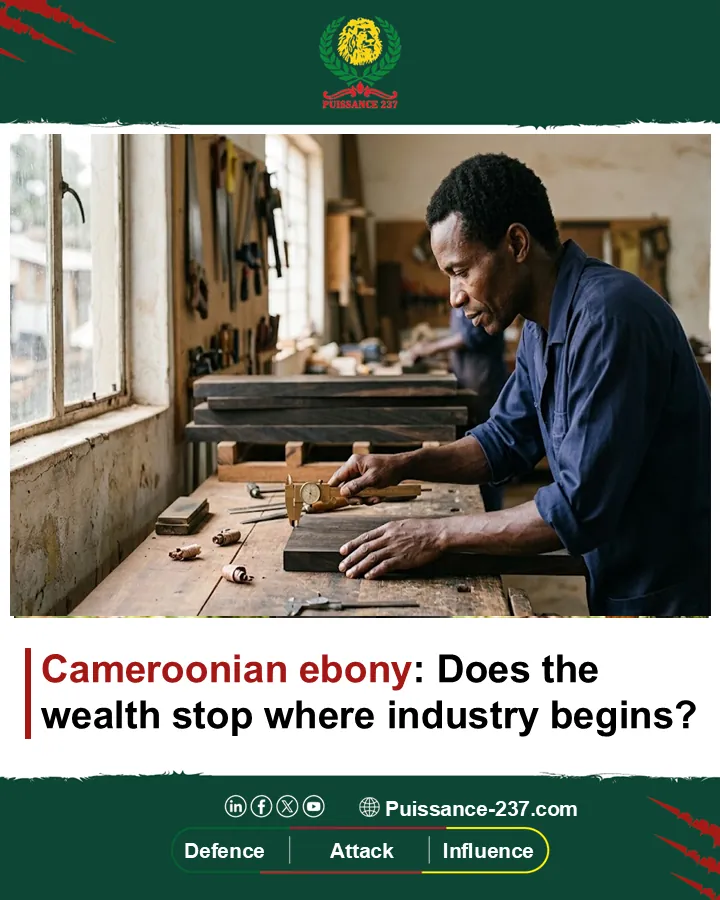
A tree felled in Cameroon can provide the wood for a guitar manufactured in the United States. Between the two lie the work of sawmill operators, manufacturing decisions, buyers’ requirements and the processes that determine the final product’s price. This is where the industrial challenge of Cameroonian ebony lies. On 8 October 2026, an initiative announced by Taylor Guitars and Crelicam to improve the management of harvesting permits brought sourcing back into focus. For Cameroon, the significance of this initiative also lies in what it reveals: control over a resource does not automatically translate into control over the activities that make it more valuable.
The wood leaves the forest, but where is the value created?
Since 2011, Taylor Guitars and its Spanish partner Madinter have owned Crelicam, a sawmill in Yaoundé. The company processes ebony used, among other applications, in musical instruments, while guitar manufacturing and assembly take place abroad. Cameroon is therefore part of an international industrial value chain, but the activities carried out on its territory do not cover every stage between the forest resource and the finished product sold on the market.
This distribution raises a practical question: which additional activities can Cameroon take control of without losing competitiveness? Precision machining, the manufacture of specialised components and the recovery of value from wood offcuts are avenues worth exploring, depending on costs, available skills and market opportunities. Crelicam’s experience also shows that value depends on the ability to develop new uses for a resource. Taylor Guitars has created markets for ebony with colour variations that some manufacturers previously considered less desirable. Innovation can therefore increase the value extracted from raw materials without increasing logging volumes.
The partnership must go beyond securing the resource
The working group announced in October 2026 is expected to develop a framework for applying for harvesting permits within clearly defined forest management units. This could improve supply predictability and wood traceability. However, no new factory or expansion of processing capacity has been announced. For Cameroon, the next step would be to pursue complementary gains: training technicians, mastering additional processes, developing local suppliers and accessing new markets.
These possibilities are not commitments that have already been secured. They require negotiations based on verifiable objectives and the interests of all parties. Progress could be measured by the skills actually acquired, the increase in operations performed locally and the participation of Cameroonian businesses in the production chain. The challenge is to ensure that the relationship with an international manufacturer helps develop national capabilities beyond its immediate sourcing needs.
Forest sustainability determines long-term industrial prospects
Ebony grows slowly, and its long-term availability depends on the regeneration of forest stands. Since 2016, Taylor Guitars has supported a research and planting programme alongside the Congo Basin Institute and local communities. Figures published for 2025 report that 47,561 ebony trees and 34,421 fruit trees have been planted since the programme began. These results demonstrate a regeneration effort, but they are not sufficient to establish that commercial harvesting is sustainable.
The future permit framework should therefore be assessed in terms of traceability, the condition of forest stocks, compliance with forestry regulations and the renewal of the resource. Defining harvesting zones does not, by itself, guarantee sustainable management. For Cameroon, protecting forest capital and improving industrial productivity must go hand in hand, particularly through the recovery of value from wood offcuts and rigorous monitoring of timber extraction.
From forest resource management to manufacturing power
In Power 237, Dr Guy Gweth, president of the African Center for Competitive Intelligence (CAVIE), places industrial development within an ambition for continental leadership built on the three-part framework of defence, attack and influence. The ebony industry illustrates what is at stake: protecting national interests, gaining ground in higher-value manufacturing activities and strengthening Cameroon’s ability to negotiate its partnerships. This ambition requires forestry policy, training, infrastructure, financing and market intelligence to work together.
The initiative involving Taylor Guitars and Crelicam therefore creates an opportunity, without prejudging its outcome. Securing supply could consolidate an existing activity; industrial progress will depend on the skills developed, the investments made and the markets captured. From the perspective of Power 237 , the challenge is to turn an internationally sought-after forest resource into sustainable manufacturing capabilities that create more value in Cameroon.
The Editorial Staff