Cameroon-Central African Republic: Can Trade Integration Shift the Regional Balance of Power?
12 October 2026
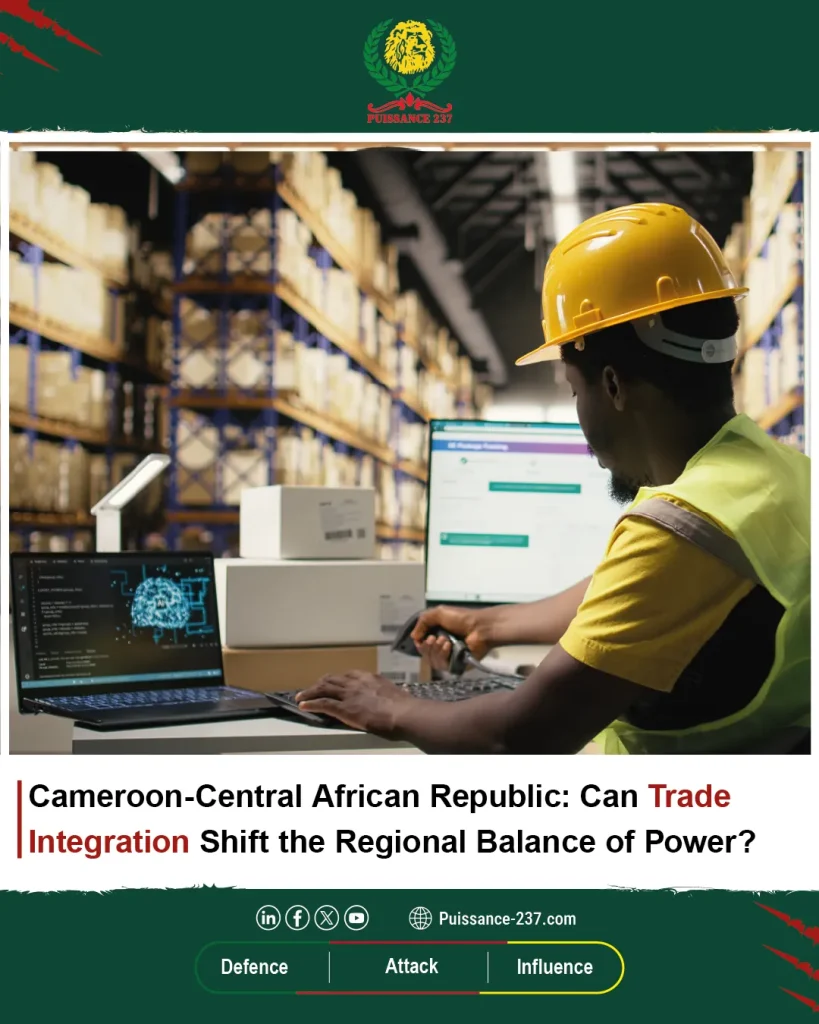
Cameroon and the Central African Republic have launched a $3 million initiative to make cross-border trade easier. Yet smoother trade routes do not automatically translate into stronger economies. The real challenge is to turn access to regional markets into productive capacity, business growth and greater influence. For Cameroon, the question is not simply how to move more goods, but how to secure a stronger position in the regional economy.
A Trade Corridor Is an Asset. Economic Power Is What a Country Makes of It.
On 6 October 2026, Cameroon and the Central African Republic launched the Project to Support the Implementation of the African Continental Free Trade Area (AfCFTA) for Cross-Border Trade, known as PAMOZ. Funded by the African Development Bank (AfDB) and implemented with technical support from the International Organization for Migration (IOM), the initiative has a budget of approximately $3 million over 24 months. It aims to facilitate trade, strengthen regional value chains and expand economic opportunities for border communities. The project focuses on key routes linking Douala with Bangui and Kousséri.
Cameroon has a valuable geographical advantage: its ports, transport networks and commercial links give it an important role in supplying landlocked countries in Central Africa. But a country can serve as a major transit hub without capturing enough of the economic value generated by that traffic. Transport, processing, storage, distribution and finance all create business opportunities, and those opportunities do not automatically go to Cameroonian companies. The strategic challenge is to turn the country’s location into stronger domestic businesses, more productive industries and a greater ability to shape regional markets. This is the broader ambition behind Power 237, Dr Guy Gweth’s strategic roadmap for Cameroon’s pursuit of continental leadership by 2050.
Who Will Capture the Value Created by Regional Trade?
Opening trade routes creates opportunities, but it also exposes local businesses to competition. As goods move more easily across borders, foreign suppliers may gain access to customers just as readily as Cameroonian producers do. The key question is therefore not only whether trade increases, but which businesses win new customers, which products gain ground and where the value generated by these exchanges ultimately remains.
Cameroon needs to identify the products its neighbours want to buy and determine where its own businesses can compete successfully. Which local producers can supply these markets at the right price and quality? Which goods could be processed locally before export? What prevents small and medium-sized enterprises from reaching buyers across the border? Answers to these questions should help direct investment, business support and training towards real commercial opportunities. The objective is to build companies that can compete beyond Cameroon, rather than assume that improved trade conditions will benefit the domestic economy on their own. This is how access to a regional market can become a source of lasting economic strength.
Winning Markets Requires More Than Easier Border Crossings
A company cannot win a market simply because the road to its customers has improved. It needs to understand demand, know its competitors, meet quality standards, manage costs and deliver reliably. It must also have enough production capacity, working capital and distribution support to serve customers over time. Without these capabilities, a new trade opportunity may remain out of reach, even when border procedures become simpler.
Cameroon therefore needs to move from market access to market conquest. Public authorities can help identify promising sectors and remove obstacles that prevent domestic firms from expanding. Businesses, in turn, must choose the markets they want to enter, prepare competitive products and build lasting relationships with buyers. Producers, processors, transport companies and distributors should be connected so that more of the value chain can develop within the country. This is the offensive dimension of Power 237 in practical terms: economic ambition must lead to concrete positions to win, capabilities to build and results to achieve. The goal is not simply to participate in regional trade, but to strengthen Cameroon’s ability to compete and expand.
Regional Cooperation Must Strengthen Cameroon’s Position
Trade depends not only on roads and transport services, but also on the rules and institutions that govern the movement of goods and people. Delays, unpredictable procedures and weak coordination between border authorities can raise costs and undermine business confidence. Cameroon therefore has a direct interest in making its trade corridors more reliable, anticipating disruptions and ensuring that regional arrangements work for the businesses that depend on them.
PAMOZ provides a framework for cooperation with the Central African Republic and international partners. Its long-term value will depend on whether this cooperation improves conditions for traders and supports stronger economic links between the two countries. For Cameroon, the opportunity is also strategic: to defend the interests of its businesses, help shape the arrangements governing regional trade and build partnerships that deliver lasting economic benefits. This is where influence becomes practical. It is not measured simply by the number of agreements signed, but by a country’s ability to shape its environment and use its relationships to advance clear national priorities.
From a Trade Project to a National Strategy
PAMOZ has a budget of approximately $3 million and a two-year implementation period. Its results should be measured not only by the activities completed or procedures improved, but also by their economic effects. Are border-crossing times falling? Are transport costs becoming more manageable? Are Cameroonian companies reaching new customers? Are local producers expanding their output, and are stronger links developing between businesses on both sides of the border? These are the kinds of questions that can show whether better trade flows are translating into stronger economic performance.
The larger challenge is to connect this initiative with Cameroon’s long-term development priorities. Better transport links will have limited impact if businesses cannot obtain financing, local industries lack the capacity to process goods or workers do not have the skills required by expanding sectors. Infrastructure, industrial development, human capital, innovation and private enterprise must reinforce one another. This is the strategic logic at the heart of Power 237: a country cannot build lasting power through isolated projects alone. It needs a clear national direction, coordinated resources and the ability to turn its ambitions into measurable results.
PAMOZ will not, by itself, change the balance of power in Central Africa. But it raises a question that Cameroon cannot afford to ignore: will the country remain primarily a gateway through which regional trade passes, or will it use that position to build stronger businesses, expand productive capacity and gain greater influence over the markets around it? Power 237, Dr Guy Gweth’s strategic roadmap for Cameroon’s pursuit of continental leadership by 2050, explores this wider challenge through the triptych of Defence, Attack and Influence. For public decision-makers, business leaders and development stakeholders, its central value lies in connecting today’s economic choices with the capabilities Cameroon needs to build for tomorrow. The task is not merely to take part in regional integration, but to turn it into a lasting source of national strength.
The Editorial Staff