Cameroon: AfCFTA, a Lever Under Conditions
23 October 2026
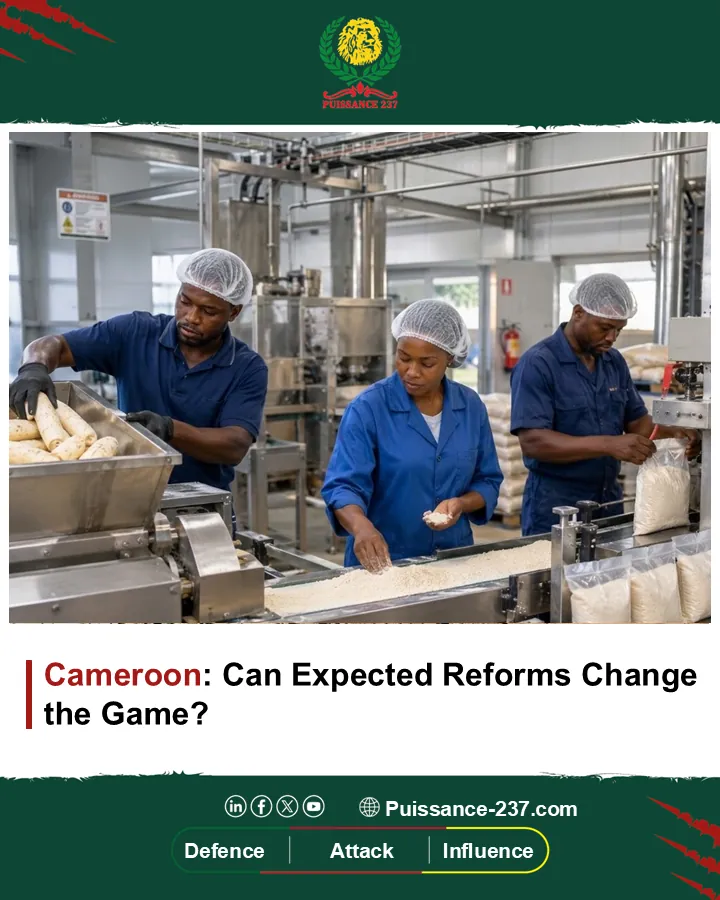
The 12th session of the Cameroon Business Forum opens in Douala around productive transformation. The theme sets an ambition: to make Cameroon a major industrial and commercial hub in Africa. But opening up a continental market says nothing, by itself, about the capacity of local businesses to respond. It is this gap that Power 237, Dr Guy Gweth’s book on Cameroon’s power strategy to 2050, helps to think through.
An expanded market does not make an industrial power
The African Continental Free Trade Area (AfCFTA) opens up prospects that go beyond national borders. But it is one thing to access more markets, and another to have the businesses, skills and supply chains needed to respond sustainably. Power 237 shifts the focus: the question is not whether Cameroon can access more markets, but whether it has the productive capacity to respond.
An economy can benefit from expanded access without proportionally strengthening its industry. If local businesses cannot produce in sufficient quantity, meet quality requirements, or deliver at competitive costs, market opening becomes an additional space of competition. The book invites us to start from resources, skills and coherence among actors, rather than from announced opportunities.
Public-private dialogue tested by its results
Created in 2009 with the support of the International Finance Corporation, the Cameroon Business Forum is a framework for consultation between the state and the private sector. Its twelfth session puts this function back at the center of debate. But the value of such a framework is not measured by the possibility of expressing concerns: it depends on its capacity to bring about trade-offs and to change the concrete conditions of production.
Power 237 goes further: if power means mobilizing national resources around common objectives, the relationship between the state and businesses cannot remain a succession of consultations without operational continuity. A forum is useful only if it produces verifiable decisions, not just declarations. This is the demand for results that the book sets as a method.
Competitiveness is decided before market access
The existence of outlets is not enough to create export capacity. A business must be able to finance its development, control its costs, guarantee the quality of its products and organize their delivery. Difficulties in accessing finance, logistical constraints and inadequate productive infrastructure are among the most documented obstacles in Central Africa.
Competitiveness therefore does not depend solely on individual business performance. It depends on the institutional environment, the availability of factors of production and the capacity to integrate into value chains. Industrial ambition requires considering production, financing, logistics, skills and market access together. Power 237 provides the framework for thinking through this articulation: power does not rest on a single factor, but on coherence among resources, skills and institutions.
Defending economic interests, not just exporting
Conquering new markets is not just about the possibility of selling products there. It also involves determining the activities in which Cameroonian businesses can develop lasting advantages and the value segments they can master. Regional power does not rest solely on available resources, but on the capacity to mobilize them in the service of a coherent ambition.
Export growth does not have the same strategic significance depending on whether businesses sell lightly processed products or master higher value-added stages. The question posed by the AfCFTA then becomes that of Cameroon’s capacity to occupy a more important place in value creation, and not just in the circulation of goods.
From announced reform to productive capacities
For the twelfth session of the Cameroon Business Forum to contribute to this ambition, the challenge is to assess reforms based on their effects on economic activity. The difficulties raised by businesses must be linked to their measurable consequences: costs and delays in procedures, access to finance, infrastructure reliability, capacity to invest or to meet the requirements of foreign markets.
This requirement for measurement echoes the importance given to statistics and collective intelligence in Power 237. A national ambition cannot be effectively steered without reliable information on existing capacities and progress made. The book offers a framework for reflection to understand why coordination among actors and monitoring of objectives matter in building economic power.
What the book contributes to the debate
Cameroon has an expanded commercial space with the AfCFTA, but the advantage it derives will depend on its capacity to produce, transform, finance and market competitively. Making continental opening a lever for power means converting national resources into productive capacities, then these capacities into lasting economic positions. It is this transformation, more than the mere multiplication of commercial opportunities, that Power 237 sets as a strategic requirement. A book to read to understand what the AfCFTA truly demands of Cameroon.
The Editorial Staff