Yaoundé 2026: ECA calls for faster Private-Sector reforms and a competitive Industrial Base
14 October 2026
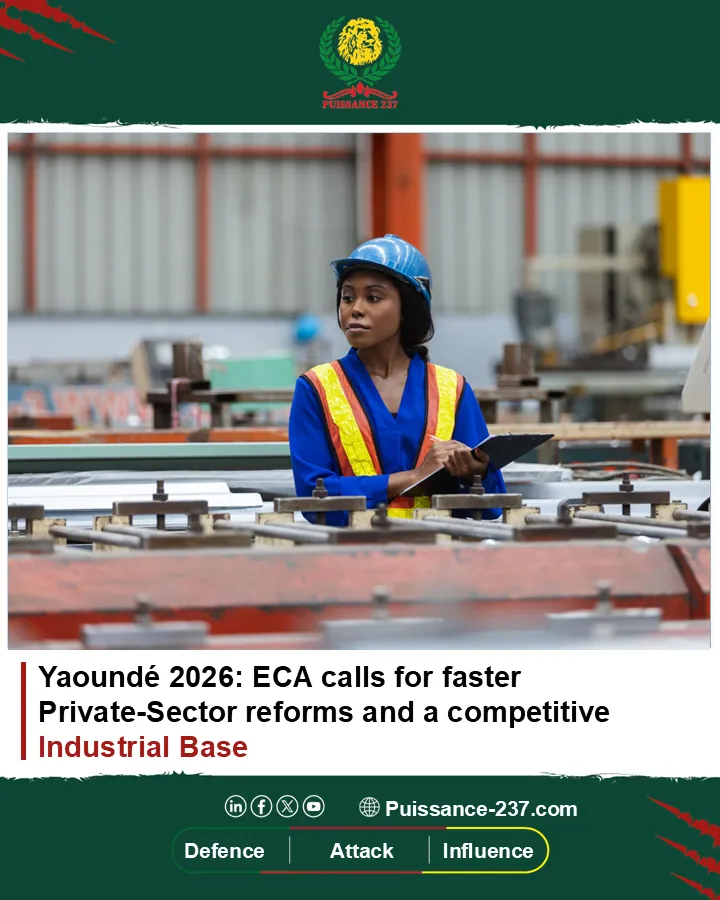
The 42nd session of the United Nations Economic Commission for Africa (ECA) opens in Yaoundé on 13 October 2026 with a central question for Central African economies: how can economic reforms translate into real industrial capacity? A recent ECA assessment highlights the gap between reforms adopted and their actual impact on businesses. For Cameroon, the challenge goes beyond improving the business environment. It is about turning resources, infrastructure and regional positioning into lasting productive advantages. This is one of the strategic directions explored by Dr Guy Gweth in Puissance 237, which places manufacturing at the heart of Cameroon’s economic power.
Reform Alone Does Not Create Production
ECA’s findings illustrate the scale of the challenge: extractive industries account for 75% of exports from the Central African Economic and Monetary Community (CEMAC), while manufacturing value added per capita remains below CFAF 150,000 in most countries in the region, compared with more than CFAF 1.6 million in Malaysia. The problem is therefore not simply the availability of resources. It is the ability to transform them locally into manufactured goods, skilled jobs and higher incomes.
Business climate reforms can facilitate access to credit, secure transactions and reduce administrative barriers. However, they do not automatically create factories, develop skills or open markets. In Puissance 237, Dr Guy Gweth calls for a shift beyond counting adopted measures towards assessing the productive capacities they make possible. For Cameroon, the decisive test is whether businesses can invest, manufacture and gain market share.
Infrastructure Must Serve a Productive Strategy
ECA also identifies inadequate productive infrastructure as a major obstacle to competitiveness. Unreliable electricity, high transport costs and weak connections between production centres and industrial zones increase operating expenses. Yet infrastructure investment alone does not guarantee the emergence of a competitive industrial base.
A road, port or industrial zone delivers its full economic value when it supports businesses and strengthens supply chains. An industrial zone with limited productive activity, a port poorly connected to inland production centres or a transport network that fails to reduce logistics costs can restrict the returns on public and private investment. The strategic priority is therefore to align infrastructure development with targeted industries, market opportunities and the actual needs of Cameroonian businesses.
Technological Mastery Must Be Built
Financing and skills represent another major constraint. A company may identify a viable market but lack the capital required to modernise its production facilities. Conversely, purchasing machinery does not guarantee effective use if technical expertise, applied research and maintenance capabilities are insufficient. These constraints reinforce one another, limiting the ability of businesses to move into higher-value activities.
Industrial development consequently requires sustained investment in innovation, financing for innovative enterprises and intellectual property protection. These priorities, highlighted in Puissance 237, can help Cameroonian businesses move beyond the mere use of imported technologies towards developing their own capabilities. The objective is not to manufacture everything domestically, but to gain greater control over strategic processes, skills and industrial segments, thereby reducing dependencies and strengthening competitiveness.
Partnerships Must Strengthen Local Businesses
Cooperation with multinational companies, industrialised economies, financial institutions and research centres can accelerate this progress. Such partnerships facilitate access to capital, technology and markets. Their contribution to Cameroon’s economic strength, however, depends on the capabilities they help develop locally.
Their value should therefore be assessed not only through announced investment volumes or short-term job creation, but also through technology transfer, the training of technicians and engineers, the integration of local suppliers and the participation of domestic companies in value chains. This approach reflects the strategic logic of Puissance 237: partnerships become instruments of economic sovereignty when they durably strengthen national players’ ability to produce, innovate and compete in regional and international markets.
From Reform to Industrial Leadership
At the midpoint of the Decade of Economic Diversification (2021–2030), Cameroon must connect reforms, infrastructure, innovation and partnerships to measurable industrial objectives. Without this coordination, improvements in the business environment may have only a limited impact on local processing, business upgrading and export diversification.
In Puissance 237, Dr Guy Gweth frames this ambition through the triptych of defence, attack and influence: protecting economic decision-making autonomy, capturing markets and strengthening Cameroon’s ability to shape its regional environment. All three dimensions require a productive base capable of supporting business competitiveness and consolidating the country’s position in African value chains. The Yaoundé session therefore brings a fundamental imperative back into focus: industrialisation must be treated not merely as a development objective, but as an instrument of national power and continental leadership.
The Editorial Team