
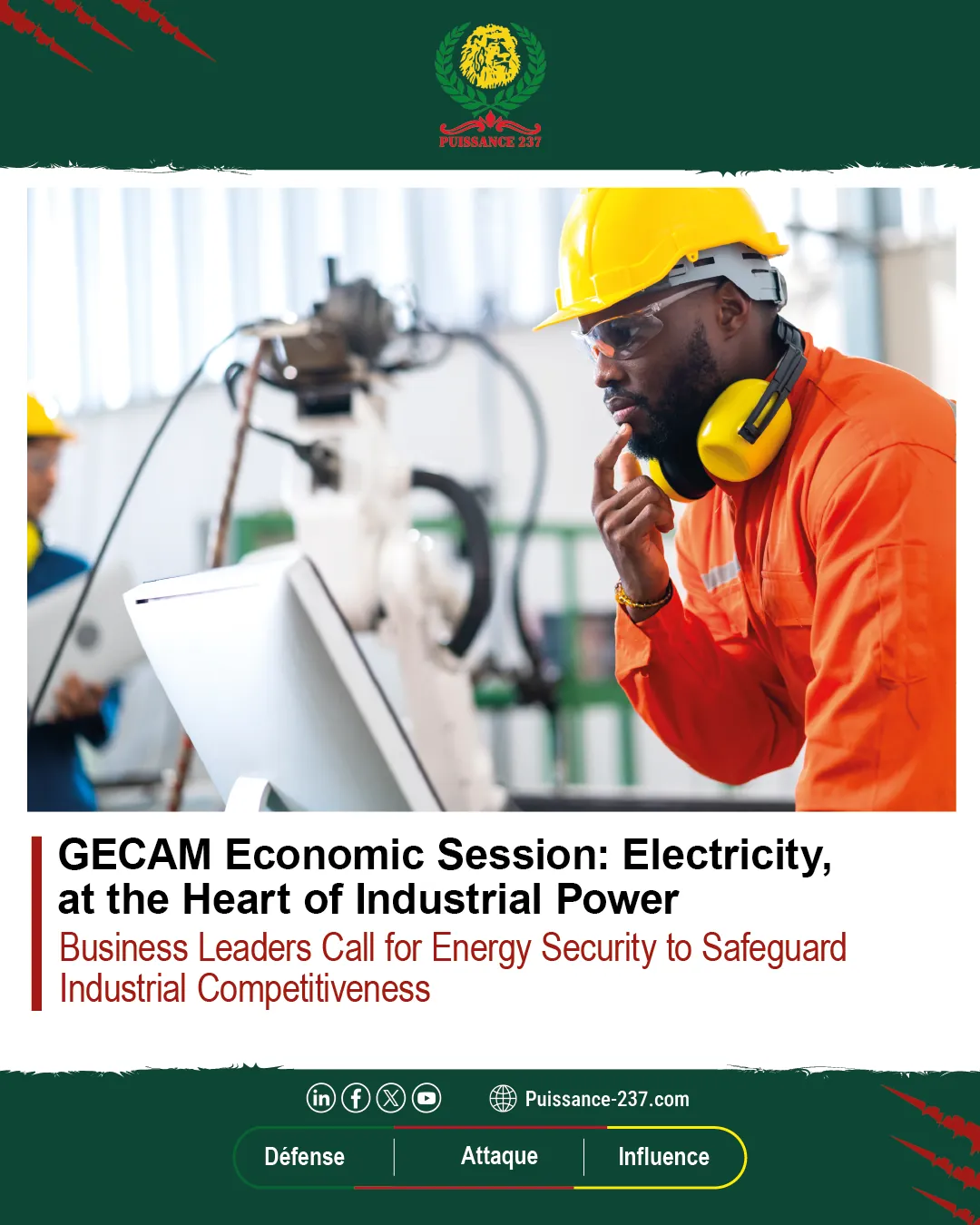
With 65% of Cameroon Employers’ Association (GECAM) member companies now relying on generators to keep operations running, the business community’s economic session, held on 10 September 2026 in Douala, placed electricity back at the center of the debate. Power cuts now threaten far more than the continuity of industrial operations: they undermine Cameroon’s ability to produce at competitive cost, access African markets and pursue its industrial ambitions.
Energy as a Strategic Asset
In the fields of energy and industrialisation, Power 237, written by Dr Guy Gweth, calls on the State to turn physical infrastructure and industrial capacity into instruments of national power. The book advocates an assertive infrastructure policy, aligned with an industrialisation and export strategy coordinated by a strategic State.
The concerns raised by GECAM confirm the relevance of this approach. Despite the additional capacity expected from the Nachtigal hydropower project, a significant share of companies still depends on generators. Backup power can cost several times more than grid electricity, driving up production costs and weakening local companies against imported goods. For Cameroon, the challenge is therefore not simply to generate more electricity, but to ensure a stable, accessible and competitive supply where economic activity is concentrated.
Defending Production, Expanding into Markets
Defence means securing the national productive base. An industrial sector exposed to power cuts, fuel costs and an unreliable grid faces production losses, rising prices and shrinking market share. State policy must treat reliable electricity for industrial zones, logistics platforms, agro-processing companies and digital infrastructure as a matter of economic security.
Offence means creating the conditions for Cameroonian products to compete and expand into regional markets. A company cannot establish itself in CEMAC or make the most of the African Continental Free Trade Area (AfCFTA) if its production costs are weighed down by backup power and inadequate infrastructure. Energy reliability is therefore both a driver of industrialisation and a commercial advantage: it lets companies produce more, deliver on time, meet standards and compete on price.
The Strategic State Put to the Test
The response cannot rest with businesses alone. It requires energy producers, transmission and distribution operators, economic administrations and industrial companies to work towards shared objectives: reducing power cuts in production hubs, improving grid reliability, cutting losses and securing electricity supply for priority sites. Only then can energy become a genuine pillar of industrial policy.
Within the framework set out by Power 237, influence also stems from Cameroon’s ability to offer a credible production environment. A country that guarantees reliable energy to its businesses strengthens its attractiveness, retains investors and projects the image of an organised economy. GECAM’s warning should be read as an invitation to turn electricity from a recurring constraint into an infrastructure of sovereignty, market expansion and national influence.
The Editorial Staff