Territorial Connectivity Could Reshape Cameroon’s Economic Landscape
18 November 2026
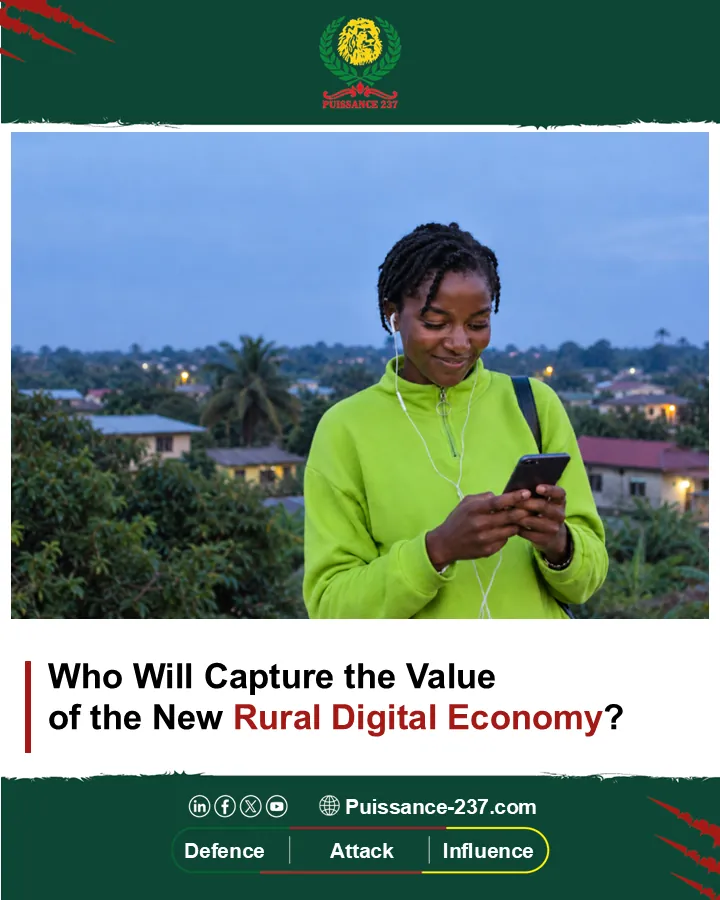
With 362 rural localities set to gain internet access, Cameroon is accelerating its digital inclusion drive through a programme that could transform the lives of thousands of people. Beyond expanding network coverage, however, a more strategic question emerges: what economic opportunities will these newly connected territories be able to unlock?
Information: An Economic Advantage That Remains Unevenly Distributed
On November 9, 2026, Ekpwassong I, in Cameroon’s East Region, hosted the inauguration of the first telecommunications facility under the rural connectivity programme of the Cameroon Digital Transformation Acceleration Project (PATNUC). Supported by the World Bank and implemented in partnership with telecommunications operators CAMTEL, MTN Cameroon and Orange Cameroon, the initiative targets 362 underserved localities. The facility inaugurated by MTN Cameroon provides 2G, 3G and 4G services, supported by a solar-powered energy system. MTN Cameroon is involved in 182 of the targeted localities.
For cocoa and coffee farmers in Ekpwassong, the arrival of connectivity opens up opportunities that go well beyond everyday communication. Access to prices across different markets, the ability to identify potential buyers and the capacity to monitor changes in demand could fundamentally alter how agricultural products are marketed. Until now, geographical isolation has limited many of these exchanges. Yet distance is not the only obstacle. Across many rural economic activities, the lack of reliable information on market opportunities, production volumes and buyers’ requirements weakens producers’ bargaining power. Better connectivity can help address this imbalance. But knowing which information to seek and how to use it remains essential.
Understanding Resources Before Seeking to Unlock Their Value
This is where the challenge becomes truly strategic. Cameroon has agricultural production zones, local expertise, natural resources and entrepreneurial capabilities whose economic value remains unevenly exploited. How can investment be directed towards the most promising activities when data on production capacity, logistical requirements and market opportunities remain fragmented? How can producers be connected to wider markets when economic stakeholders lack a sufficiently accurate picture of the resources available across the country’s different territories?
In Power 237, Dr. Guy Gweth highlights the role of statistics in building national power. This perspective deserves practical consideration in Cameroon’s rural connectivity strategy. The country would benefit from developing a dynamic mapping system of its production zones, documenting value chains, output volumes, infrastructure, skills and constraints specific to each area. Regularly updated through contributions from local administrations, professional organisations and economic stakeholders, such a system would help guide investment decisions and align producers’ needs with market opportunities. Connectivity would then provide access not only to the internet, but also to a more comprehensive understanding of the national economy.
Making Skills and Knowledge Flow Alongside Data
Such knowledge, however, will only generate results if it is shared and put to use. Producers cannot remain the sole beneficiaries of a digital policy designed without their active involvement. Local and regional authorities, professional organisations, universities, businesses and public institutions all have a role to play in identifying needs and developing appropriate solutions. In this context, collective intelligence, which Power 237 identifies as a foundation of national power, becomes particularly relevant. A territory becomes more competitive when its stakeholders can pool their knowledge, exchange experience and coordinate their initiatives.
This calls, among other things, for closer links between educational institutions and production areas, stronger connections between cooperatives and buyers, and the development of digital services tailored to local realities. Young people’s skills could also be mobilised to create solutions for agriculture, trade and local economic management. As the available data grows, artificial intelligence applications could help anticipate market trends, analyse agricultural yields and improve production planning. Yet these tools will only be effective if they are supported by reliable local data, national expertise and the capacity to control and use them effectively.
Beyond Digital Coverage: The Challenge of Economic Competitiveness
The risk, ultimately, is to measure the success of this initiative solely by the number of sites installed, without paying sufficient attention to the changes they bring to economic relations. A locality may have 4G coverage and still sell its produce under the same conditions as before, due to inadequate logistics, limited market information or weak bargaining power. Connectivity must therefore be accompanied by clear economic objectives: improved market access, the development of local businesses, stronger digital skills and greater value creation from local production. Local authorities and professional organisations should be actively involved in monitoring these outcomes.
This is also a matter of national vision. By 2050, Cameroon cannot aspire to become a regional power while leaving part of its human, intellectual and productive resources outside its decision-making and economic networks. The objective should not be to make rural communities mere beneficiaries of digital transformation, but active participants in economic competition. The approach advocated in Power 237 calls precisely for the mobilisation of all the country’s resources, a better understanding of its strengths and their organisation around shared national objectives. The new telecommunications infrastructure provides an opportunity to begin this process. What remains is for Cameroon to turn territorial connectivity into genuine economic capacity and strategic action.
The Editorial Staff