Lake Chad: The Strategic Stakes Behind the BIR Reinforcement
26 October 2026
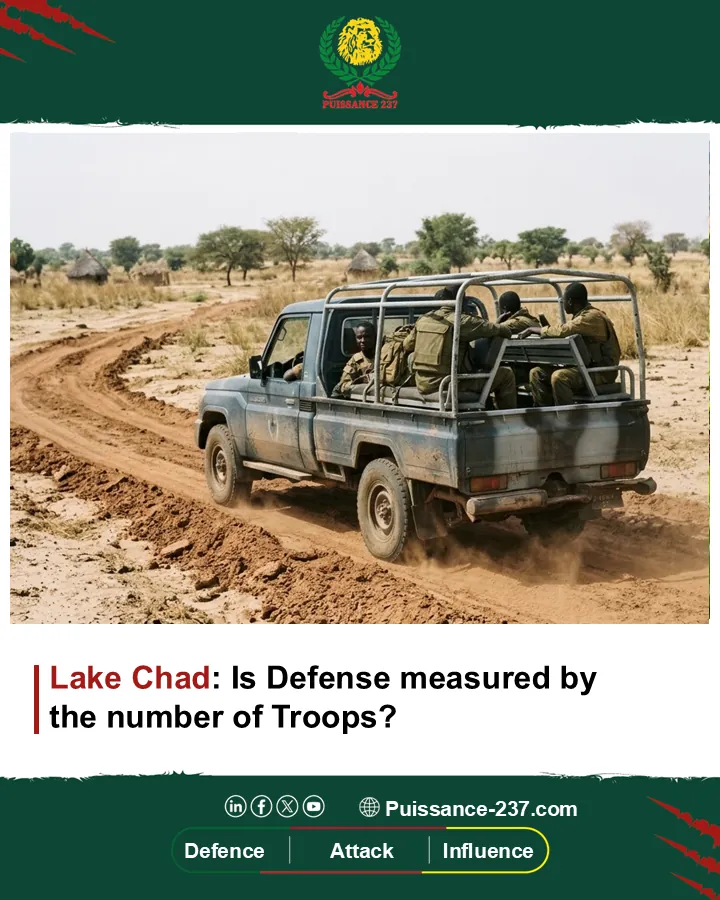
In the Lake Chad Basin, territorial defence faces a particular challenge: armed groups exploit borders, waterways and gaps in coordination between the forces deployed in the region. In Cameroon, the expansion of the Rapid Intervention Battalion (BIR) presence around the lake, with new bases in Bargaram and Hilé-Alifa, places this challenge at the heart of the country’s national defence strategy.
Sovereignty Is Also Decided on the Ground
BIR Lake Chad is expected to comprise approximately 1,000 personnel, nearly 800 of whom had already been deployed, according to information published in early October 2026. The new bases bring security forces closer to areas affected by armed incursions. In Bargaram, violence had contributed to the displacement of families and disrupted farming, livestock and commercial activities.
These figures point to an issue that goes beyond increasing troop numbers. In Chapter XVI of Power 237, which examines the strategic role of the national army, Dr Guy Gweth presents territorial defence and border protection as foundations of Cameroon’s national power. Sovereignty is not limited to the existence of recognised borders; it also requires the State to protect its population and prevent armed groups from establishing a lasting presence in areas they seek to control. In the Far North Region, military deployment must therefore be assessed by its ability to restrict armed groups’ operational freedom and restore security in exposed communities.
Military Resources Must Operate as an Integrated System
BIR Lake Chad operates in an area where several military components are already deployed, including the 4th Joint Military Region, other BIR units, the Special Forces and the Multinational Joint Task Force (MNJTF). This coexistence matters: operational effectiveness depends not only on the capabilities of individual units, but also on how they complement one another. An analysis published by the Institute for Security Studies highlights coordination difficulties among the forces and the need to clarify operational responsibilities.
The challenge is organisational as much as material. Units may have personnel, equipment and bases without automatically delivering optimal collective results. When information flows poorly or responsibilities overlap, response times increase and some areas risk remaining insufficiently monitored. Coordination must therefore enable intelligence to be consolidated, missions to be clearly allocated and resources to be concentrated where threats are evolving. For Cameroon, the challenge is to integrate the BIR reinforcement into the wider defence system rather than allow it to operate as an additional resource alongside existing forces.
Territorial Control: A Condition for Economic Recovery
In Bargaram, insecurity has affected a locality regarded as an economic centre within the Hilé-Alifa district. Population departures have disrupted agricultural and commercial activities, while the new military installations are intended to bring security forces closer to communities and encourage residents to return.
This link between defence and economic activity echoes the second dimension of Chapter XVI of Power 237. Dr Guy Gweth highlights the army’s potential contribution to economic and social development, training, skills transfer and national cohesion. In the Lake Chad region, the military’s primary contribution remains security; however, security can create the conditions for residents to return, trade to resume and agricultural land to be brought back into use. Restoring livelihoods will also depend on civilian administration, infrastructure and access to essential services. Security is therefore a prerequisite for economic recovery, but it cannot replace it.
This distinction matters when assessing the results of the deployment. The number of troops mobilised or bases opened indicates the resources committed. It does not, by itself, measure the outcomes achieved. Trends in attacks, the safety of movement, the return of displaced residents and the resumption of local economic activities provide complementary indicators of whether territorial control is translating into tangible improvements in community life.
Intelligence and the Modernisation of the Army
The third dimension of Chapter XVI emphasises the continuous transformation of Cameroon’s armed forces, particularly through equipment modernisation, improved training, and stronger intelligence and cyber-defence capabilities. This perspective is especially relevant around Lake Chad, where armed groups exploit mobility, waterways and their knowledge of the terrain to surprise deployed forces.
The response therefore cannot rely on firepower alone. It requires up-to-date knowledge of adversary movements, routes used and areas where populations remain exposed. Information collected must be verified, cross-checked and transmitted to authorised decision-makers to guide operational choices. A better understanding of the terrain can help adapt patrols, reduce surveillance blind spots and allocate resources according to observed risks. Strategic intelligence plays a decision-support role here: information has operational value only when it improves anticipation and enables more effective action.
Modernisation must also account for the specific characteristics of the Lake Chad Basin, including marshlands, islands and navigable waterways. Analyses of the new deployment highlight the need to equip bases with the capabilities required to operate beyond their immediate locations. Equipment selection, personnel training and the adaptation of capabilities to local terrain are therefore inseparable from operational effectiveness.
Embedding Defence in a National Ambition
The deployment of BIR Lake Chad brings together several dimensions of Cameroon’s national power: territorial sovereignty, the organisation of defence resources, the quality of intelligence and the protection of the conditions necessary for development. None is sufficient in isolation. Additional bases can strengthen the military presence, but their strategic value depends on coordination between forces, their ability to track changes in the threat environment and cooperation with neighbouring countries.
In Power 237, Dr Guy Gweth places the national army at the heart of Cameroon’s ambition to become a major African power by 2050. Chapter XVI therefore provides a framework for assessing the Lake Chad deployment beyond announcements about troop numbers and infrastructure. Defence must help protect the territory, preserve stability and create the conditions for communities to resume their activities. Military power is built through coherence between the resources deployed, strategic decision-making and the outcomes achieved on the ground.
The Editorial Team