
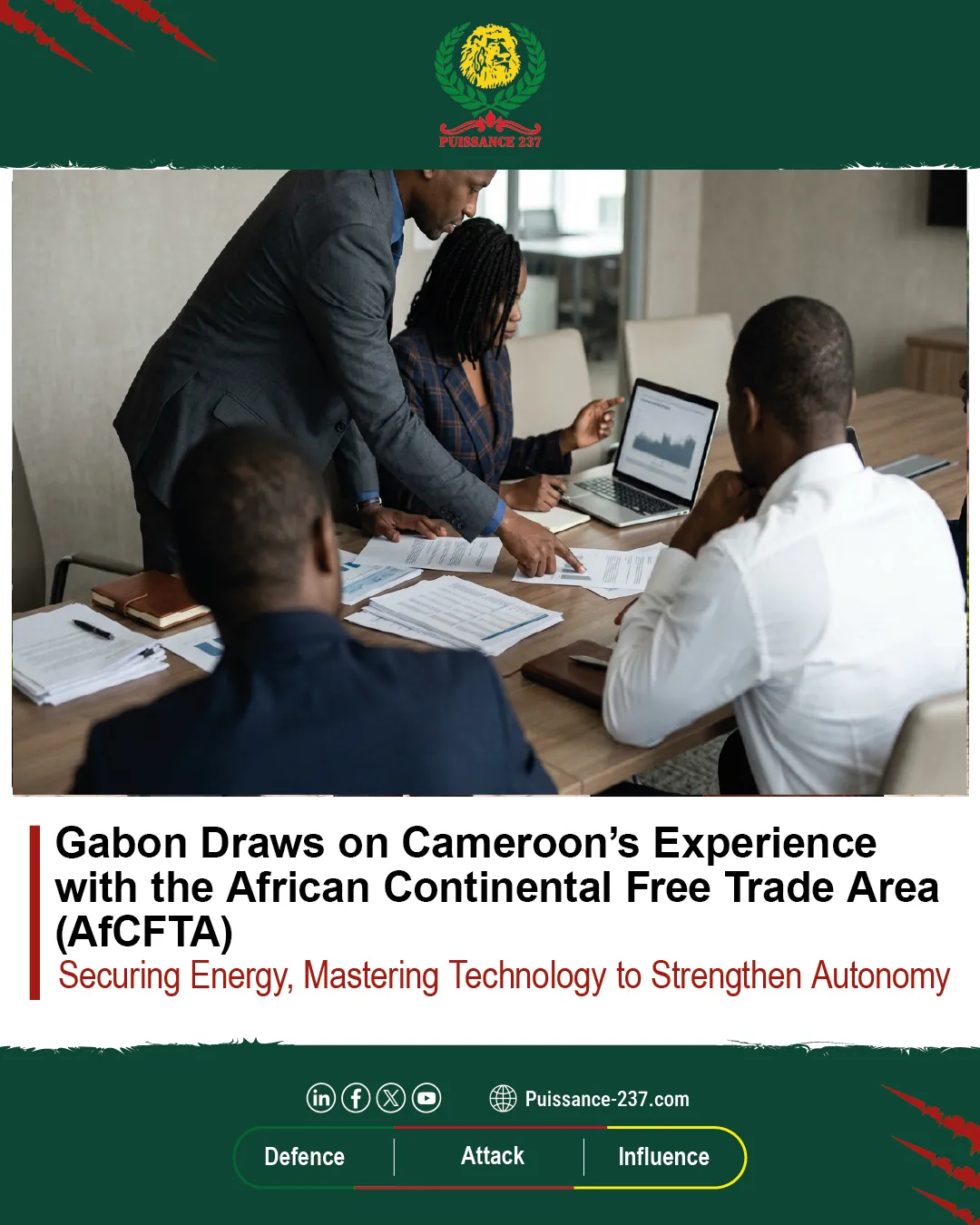
In Yaoundé, the African Continental Free Trade Area (AfCFTA) has moved beyond being simply an integration project and has become a field of observation. From September 12 to 16, 2026, Gabonese officials from the trade and customs authorities, together with private-sector representatives, came to examine the procedures, institutions and early practices through which Cameroon is putting the continental framework into practice. The visit places Cameroon in an unusual position within the sub-region: that of a country whose experience is already attracting the attention of its neighbours. The challenge now is to turn that experience into contracts, partnerships and a stronger economic presence across Central Africa.
What Libreville Came to Understand
Gabon has recently revised its national AfCFTA strategy to diversify its exports, develop value chains and increase local processing. But a strategy alone does not make trade happen. It requires companies ready to produce and export, a clear understanding of rules of origin, effective customs procedures, access to trade finance and networks capable of reaching customers.
This transition from political ambition to commercial execution is what the Gabonese delegation came to examine. Cameroon, which has been involved in the Guided Trade Initiative since 2022, has already begun putting AfCFTA procedures to the test. This experience gives Yaoundé a particular responsibility: not simply to explain how the system works, but to use this new regional interest as an opportunity for its own economic operators.
The Advantage Exists, but Market Access Still Has to Be Built
Within the Central African Economic and Monetary Community (CEMAC), Cameroon has 91 companies and 1,328 products approved under the community preferential trade regime, representing 72.4% of the 1,834 approved products. Gabon has 14 companies and 249 products. These figures do not directly reflect export volumes, but they indicate that Cameroon is currently better prepared than its neighbour to make use of regional trade preferences.
This lead remains fragile. An approved product is not necessarily a product that has found a buyer, and preferential customs treatment does not resolve transport costs, distribution, standards or trade finance. The challenge is therefore to move from administrative readiness to commercial presence: finding the right partners, securing deliveries, responding to local demand and establishing a lasting position for Cameroonian companies.
Gabon as a First Market for Action
Gabon’s drive to diversify its economy is creating needs that Cameroon can anticipate. The country’s economic transformation is generating demand for inputs, materials, packaging, equipment, logistics services, maintenance, digital solutions and training. The opportunities therefore extend beyond the export of finished goods to participation in the emerging value chains.
For Cameroon, the challenge is to build on the visit. Public authorities, business organisations, banks, companies and diplomatic missions need to be able to identify priority sectors, connect the right stakeholders and support partnerships from the initial contact through to contract execution. Without this follow-through, the experience shared will remain an experience that was simply observed. With it, the visit can translate into genuine economic presence.
The Region as a Platform for Expansion
The situation illustrates the approach developed through Power 237. Led by Dr Guy Gweth, the initiative presents Cameroon’s regional power as the ability to turn its economic assets, expertise and strategic positioning into concrete capacity for action. The Gabonese mission offers a practical example of this dynamic: Cameroon’s experience with the AfCFTA can become a foundation for deeper economic cooperation while creating new opportunities for its companies to enter neighbouring markets.
The Editorial Staff
From this perspective, the Gabonese mission is more than a technical exercise. It creates an opportunity to connect Cameroon’s institutional experience with its economic diplomacy, market intelligence and the regional expansion of its companies. National interests and regional cooperation can therefore reinforce each other when each cooperation initiative also creates concrete opportunities for Cameroonian economic operators.
The Strategy Behind Cooperation
The defence–conquest–influence framework helps clarify what is at stake. Defence means ensuring that Cameroonian companies have favourable conditions for accessing regional markets by simplifying procedures and reducing logistical bottlenecks. Conquest means identifying the needs of neighbouring markets ahead of competitors and supporting companies through the entire commercial process, from the first opportunity to sales, service delivery and follow-up.
Influence in the region, finally, depends on being useful to other economies: providing solutions, connecting businesses, sharing expertise and facilitating trade. This is how influence is built through commerce. It is not simply a matter of visibility; it is reflected in a country’s ability to establish a presence in the networks where contracts, investments and supply chains are shaped.
What This Visit Must Deliver
The mission will only be fully successful if it leaves a tangible economic footprint. In the coming months, it should be possible to identify the sectors targeted, the companies connected, the contracts signed, the exports completed, the partnerships established and the obstacles removed. Gabon will need to demonstrate that its AfCFTA strategy is strengthening its exporters. Cameroon, for its part, will need to demonstrate that its experience can translate into greater regional reach.
This is the strategic dimension highlighted by Power 237: regional power is built through the ability to act, connect economic interests and turn cooperation into lasting positions. The Gabonese visit shows that Cameroon already has assets to build on. The next step is to convert this experience into partnerships, market access and a stronger presence for Cameroonian companies across Central Africa.
The Editorial Team