
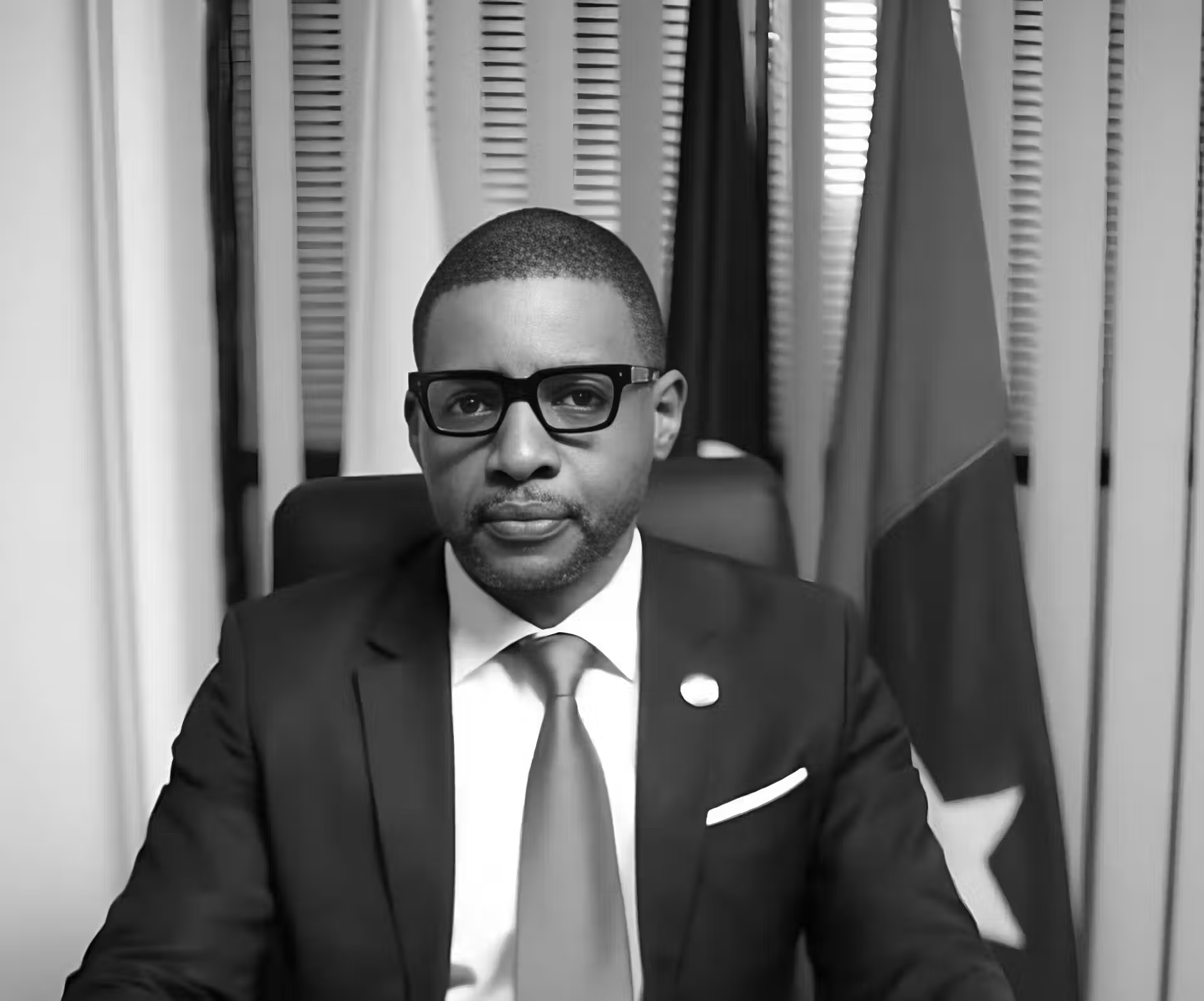
The presidential election of 12 October has reignited the debate on Cameroon’s strategic trajectory. In an exclusive interview granted to Le Messager No. 8621, Dr Guy Gweth, a leading figure in African competitive intelligence, delivered an incisive analysis of the stakes through the prism of Power 237: For a Strategy of Regional Influence 2025–2050.
The author passionately advocates for the emergence of a strategic state equipped with proactive competitive intelligence, the only path towards achieving regional power status by 2050.
The mandate of power: a three-phase roadmap
Following the election, Dr Gweth clearly outlined the mandate he expects from the future president to transform the Power 237 vision into reality. The book proposes a detailed roadmap structured around a three-phase action plan: The Foundations (2026–2033): aimed at building a solid base through institutional strengthening, massive investment in human capital, and economic diversification. The Deployment (2034–2042): focused on innovation, regional integration, and active diplomacy. The Radiance (2043–2050): intended to consolidate achievements and make Cameroon a leading model of development.
The success of this strategy will be measured by precise and ambitious indicators, including the doubling of GDP per capita, a significant rise in the Human Development Index (HDI), foreign direct investment reaching at least 15% of GDP, and a corruption perception score above 70/100. As for financing, ten relevant sources are identified, ranging from fiscal optimisation to the rational mobilisation of the diaspora.
Hard, Soft and Smart Power: the triangulation of credible leadership
The expert deeply regretted the lack of explicit integration of the concepts of Hard Power, Soft Power and Smart Power by the candidates during the campaign. He emphasised that a candidate’s credibility depended on concrete commitments across this triptych: Hard Power required guarantees of substantial investment in the defence industry and the acceleration of strategic infrastructure, citing the example of unblocking the Port of Kribi to strengthen the country’s export capacity. Soft Power demanded strong commitments to transform Cameroon into an African academic hub and to promote national culture internationally. Smart Power, finally, needed to be expressed through the commitment to pursue assertive economic diplomacy, transforming embassies into instruments for promoting trade and investment.
Competitive intelligence: a major strategic deficit
The analysis of the twelve presidential candidates’ programmes highlighted an explicit and systemic deficit in competitive intelligence. Although several proposals (mass industrialisation, the fight against corruption, fiscal reforms, economic sovereignty) imply economic warfare and strategic monitoring, Dr Gweth deplores the absence of details on the competitive intelligence mechanisms to achieve these objectives. He recalled that competitive intelligence is “a mindset, a system and a coordinated process for collecting and analysing useful intelligence to support decision-making in a competitive environment” and stressed the lack of “anticipation, defence, attack and influence skills” within the elite.
He also called for the integration of digital sovereignty as an essential component of national Hard Power, which requires the strategic transformation of intelligence services – as in the training he has already provided to the General Directorate for External Research (DGRE) – so that “master spies” become the primary actors in economic warfare.
Nigeria, first mission and sovereignty imperative
According to the expert, the new Head of State’s first international mission should be the reactivation of a strategic partnership with the Federal Republic of Nigeria. This step, which would immediately embody the Smart Power approach advocated, is a priority in terms of national security, geoeconomics, and regional power ambition. The alliance is considered a sine qua non condition for ensuring stability in the face of the asymmetric threat of Boko Haram, while the Nigerian market, with its 230 million consumers, represents a major commercial and logistical opportunity, notably within the framework of the African Continental Free Trade Area (AfCFTA).
The key to success: the institutionalisation of strategy
Faced with the paradox between the brevity of political mandates and the long-term patience required for a plan spanning 2025–2050, Dr Gweth proposed a radical solution: the institutionalisation of an independent strategic vision. To counter the personalisation of power and institutional weakness, he recommends as an absolute priority the creation of a strategic steering structure directly attached to the Presidency. This entity, which should act as a true “strategic brain” endowed with autonomy and legal authority, is intended to transform intelligence into political action and to safeguard strategic functions from partisan influence.
In conclusion, Dr Gweth urged the future president to focus on three crucial points: to mobilise top-tier human resources, to establish a new social contract built around a strategic state as the primary actor of collective intelligence, and to set up a holistic intelligence bureau to monitor, investigate and advise independently. The goal is to move from reactive management to a proactive posture of economic warfare, enabling Cameroon to become a regional power through mastery of the global chessboard.
Download the full interview HERE.
The Editorial Team