
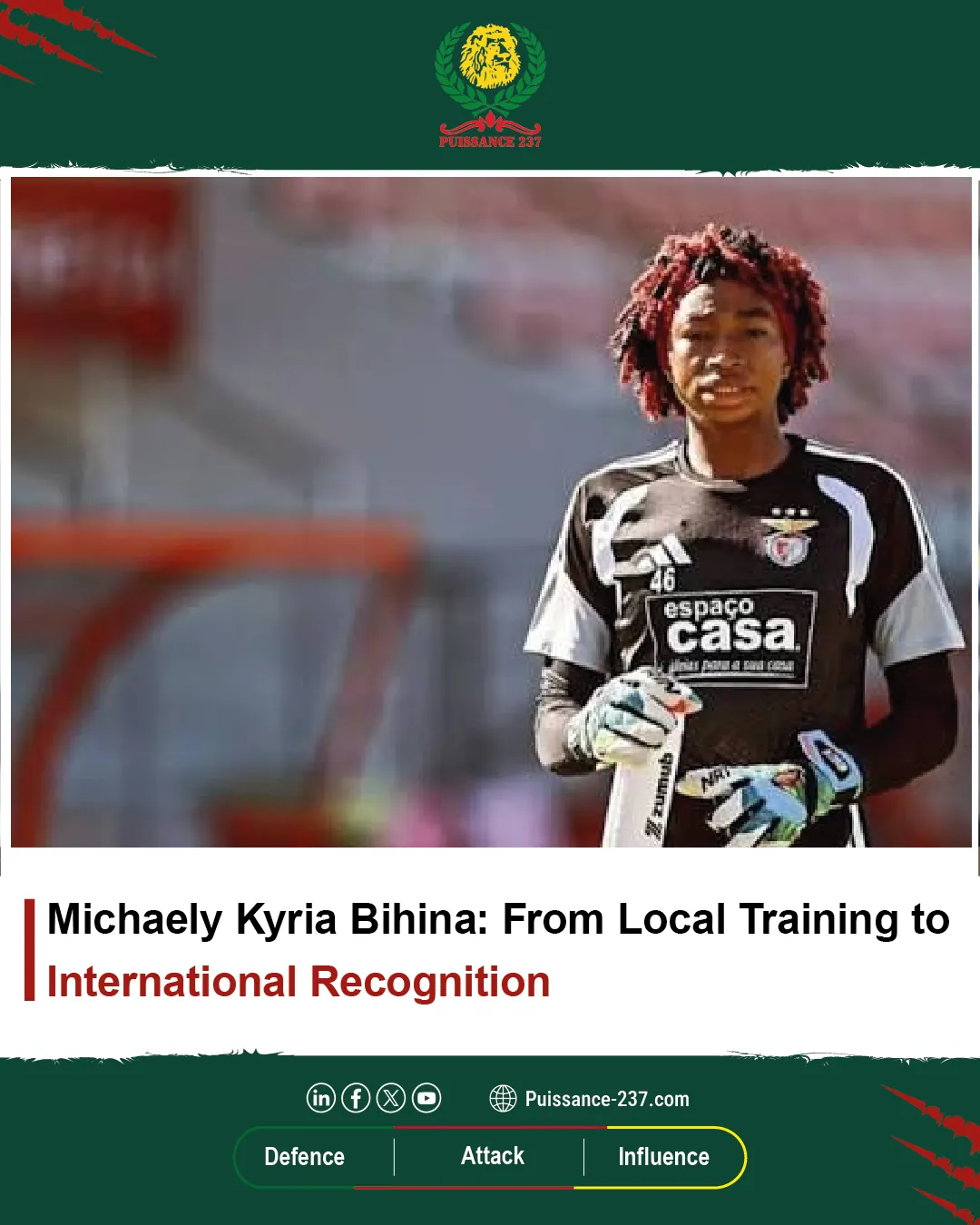
Human capital is a resource whose value is shaped not only by the skills people acquire, but also by the experiences, environments and responsibilities through which those skills develop. Michaely Kyria Bihina’s journey, from her early career in Cameroon to Benfica and her contribution to the Indomitable Lionesses’ 2026 Africa Cup of Nations triumph, offers a concrete example of how this process unfolds.
When a Skill Moves to a New Level
The significance of Bihina’s journey lies less in the clubs she has played for than in what her progression reveals. After starting her career with Éclair de Sa’a in Cameroon, the goalkeeper moved to Portugal in 2022 to join Racing Power. She helped the club win the league and secure promotion to the top flight. The following season, she was named the best goalkeeper in the Liga BPI. In February 2026, Benfica signed her on a contract running until 2029.
Her progression highlights an important dynamic: skills gain value when they are tested in different environments, exposed to higher standards and given opportunities to be recognised and repositioned. Moving from one setting to another does not replace the foundations built through initial training. It adds new performance benchmarks, professional experience and networks that make a capability easier to assess. For a country, this matters as much as the size of its initial talent pool.
When Recognition Turns a Skill into an Asset
Bihina’s Liga BPI award and subsequent move to Benfica represent two distinct forms of recognition. The first established her individual performance at a high level of competition; the second turned that recognition into a professional opportunity at one of Europe’s leading clubs. Her ability became increasingly visible, comparable and sought after.
The 2026 Africa Cup of Nations provided another form of recognition. Against Nigeria in the quarter-finals, Bihina made nine saves in a 1–0 victory. In the semi-final against Morocco, she saved three penalties in the shootout. Cameroon went on to win the tournament against Malawi, while Bihina received the Golden Glove awarded to the competition’s best goalkeeper.
The strategic significance extends beyond the sporting results. When a capability is recognised across different environments, a country gains a clearer picture of what that capability can deliver, where it is being exercised and which professional networks it has entered. Human capital therefore becomes more visible and easier to identify, connect and mobilise.
Knowing Skills Means Knowing Capabilities
This is an often overlooked dimension of human capital. A country may have a substantial pool of talent without knowing precisely where its capabilities are located, how they are specialised, what responsibilities they hold or which ecosystems they have entered. Yet that knowledge can determine whether the right capabilities can be mobilised when they matter.
Bihina’s career illustrates this at a very concrete level. A goalkeeper who began her career in Cameroon went on to build a professional career in Portugal, join Benfica and return to international competition with the Cameroonian national team. Her trajectory connects several worlds that are rarely considered together: national training, the international professional market, European sporting networks and national representation.
Power 237 and the Strategic Value of Human Capital
Bihina’s journey offers a practical illustration of an idea developed in Power 237, Dr Guy Gweth’s strategic blueprint for Cameroon’s regional power. The book draws on consultation, analysis and strategic foresight to examine how Cameroon can develop and combine its different sources of power. Its framework includes hard power, soft power and smart power.
Within this framework, human capital is more than a development resource. It is part of a country’s capacity to create value, build influence and project power. Bihina’s career illustrates this at an individual level: a Cameroonian capability gains recognition abroad, enters high-level professional networks and later contributes to a national achievement that raises Cameroon’s visibility. The strategic challenge is therefore to know where such capabilities are, understand the networks they have built and create ways to connect them with national priorities.
From Individual Recognition to Collective Power
Sport makes this dynamic particularly visible because performance is so readily observed. A player competing for a major European club operates within a wider network of competitions, institutions, partners, media and professionals. That network can extend the reach and visibility of the country she represents. When she later becomes a key contributor to a national team that wins a continental title, several layers of recognition come together.
This reflects a central idea of Power 237: regional power does not come from a single resource. It depends on the ability to combine different capabilities and turn them into greater national influence. Michaely Kyria Bihina’s career shows what this can mean in practice for human capital: developing talent at home, following its progression abroad, understanding the positions it occupies internationally and creating opportunities for that expertise to contribute to national influence.
The Editorial Staff