
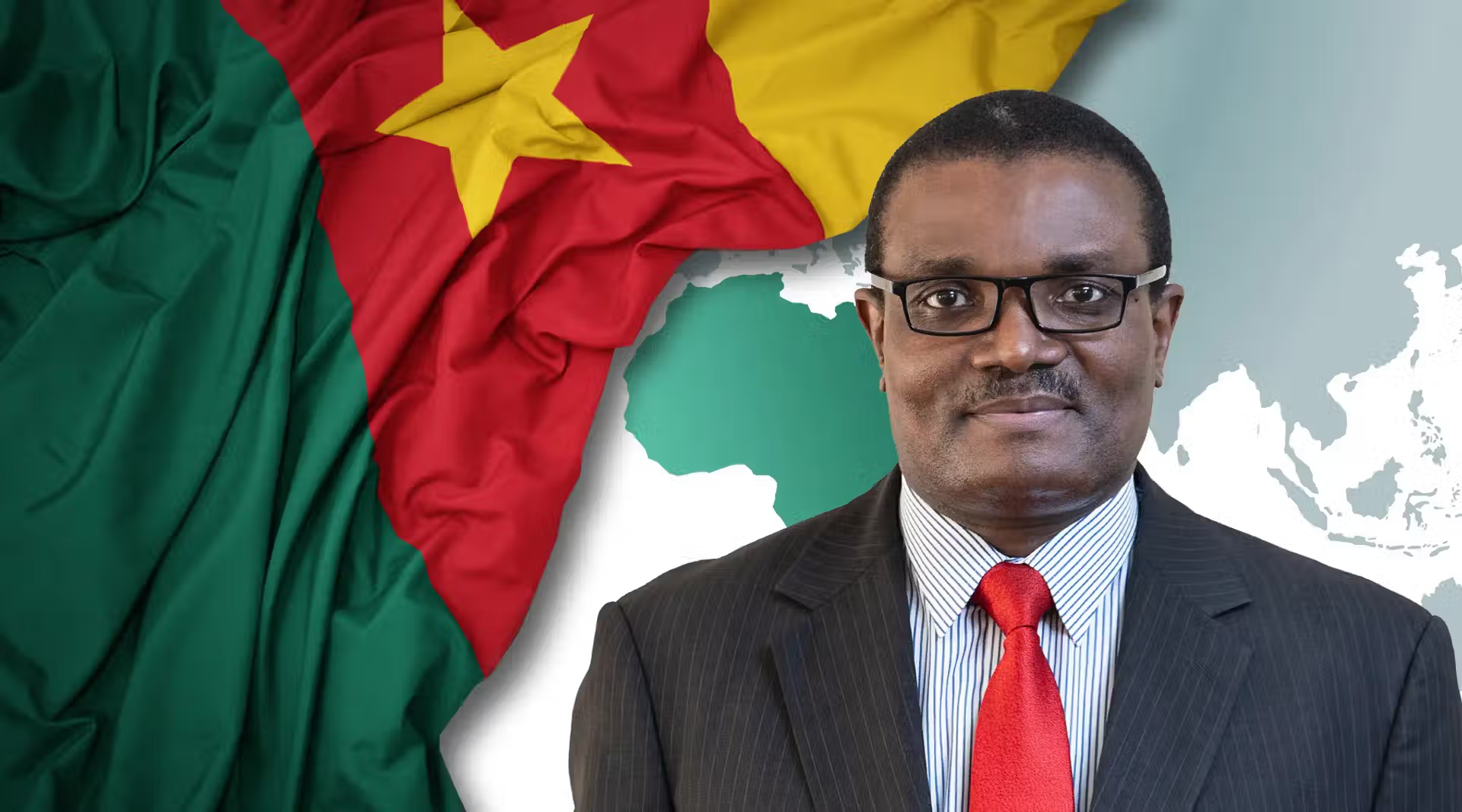
This article is part of a series analysing the influence of Power 237, published in January 2025, on the political and social programmes of the twelve candidates contesting the 12 October 2025 presidential election. Using the analytical framework developed by the African Centre for Competitive Intelligence (ACCI) — the hard, soft and smart power triptych — this impartial study explores how deeply the national power strategy proposed by Dr Guy Gweth for 2025–2050 has shaped each candidate’s vision.
In alphabetical order, the focus here is on Jacques Bouhga Hagbe, candidate of the Cameroon National Citizens’ Movement (MCNC), and author of the programme-manifesto Kamerun: Proposals for a New Beginning.
Strategic Alignment: Sovereignty and National Renewal
Jacques Bouhga Hagbe’s programme outlines a radical transformation of the state, the economy, and the social contract. His vision is rooted in national and pan-African sovereignty, echoing the central themes of Power 237: human capital, effective governance, and continental integration.
Politically, his platform calls for a deep institutional refoundation — including the adoption of a new constitution, the transfer of electoral supervision to the Supreme Court, and the strengthening of parliamentary powers. This direction reflects Chapter XIII of Power 237, which stresses that democracy, the rule of law, and institutional legitimacy are indispensable foundations for building lasting national strength.
The candidate’s approach effectively blends all three dimensions of strategic power: hard power (a strong state and robust institutions), soft power (human capital and social cohesion), and smart power (synergy between state and non-state actors, alongside regional integration).
Convergence of Economic Pillars
Jacques Bouhga Hagbe’s economic programme stands out for its emphasis on monetary and financial sovereignty: withdrawal from the CFA franc, the creation of a new currency — the Krou — and the establishment of an African Monetary Fund to finance continental development.
Industrialisation, support for local SMEs, and the development of African value chains all align with the four core pillars of Power 237: mobilisation of domestic resources, stimulation of technological innovation, promotion of sustainable growth, and regional economic integration.
His innovative “100 Francs Model” also reflects a participatory and inclusive vision — one that democratises the economy while strengthening financial inclusion.
Human Capital and National Cohesion
At the heart of Jacques Bouhga Hagbe’s power strategy lies human and social capital. Education, health, and culture are treated as essential levers for building an enlightened, healthy, and culturally grounded society.
Power 237 emphasises that human capital and civic engagement are vital to ensuring national resilience and regional influence. The proposed cultural renewal — symbolised by the renaming of the country as Kamerun — represents a quest for identity and national cohesion.
Conclusion
This comparative analysis shows that Jacques Bouhga Hagbe’s programme demonstrates a strong convergence with the core ideas of Power 237. From strengthening the rule of law and achieving economic sovereignty to investing in human capital and cultural renewal, his vision reflects an integrated strategic approach.
It confirms the book’s influence on the formulation of development policies and the definition of an autonomous and sustainable model of national power.
The Editorial Team