Food Imports: The Challenge of Local Production
29 October 2026
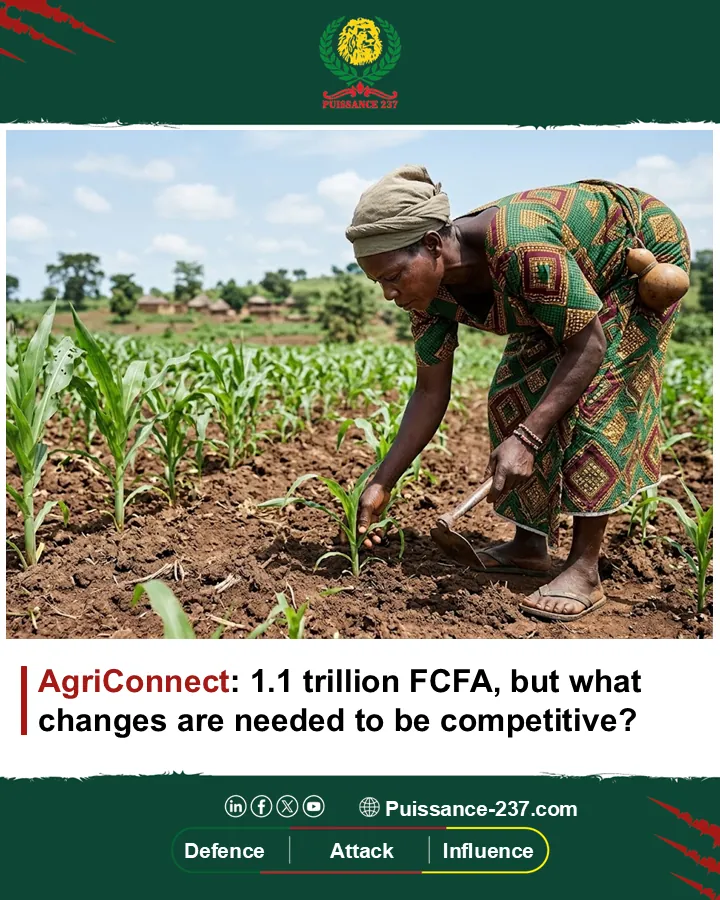
Cameroon aims to reduce its food import bill by 28% by 2030, even as its agri-food sector accounts for 17% of GDP and 42% of employment. The launch of a new compact with the World Bank brings renewed attention to the obstacles holding back local production and the country’s ability to meet its own food needs.
Precision Agriculture: An Untapped Opportunity
Launched on October 21, 2026, with support from the World Bank Group, the AgriConnect Compact targets eight value chains: maize, rice, cassava, cocoa, soybeans, oil palm, dairy, and fisheries and aquaculture. Its 24 planned interventions cover seeds, mechanization, irrigation, rural infrastructure, storage, processing, and access to finance. The estimated investment needs amount to $1.87 billion for the 2026-2030 period. Achieving the import-reduction target will depend on the ability to improve productivity and strengthen the competitiveness of these value chains.
The chapter on precision agriculture in Power 237 provides a useful starting point for examining this challenge. It recommends modernizing agricultural practices through advanced technologies to increase yields, use inputs more efficiently, preserve natural resources, and strengthen food security. This perspective shifts the focus beyond expanding cultivated areas or mobilizing more funding. The strategic challenge is to produce more efficiently, using available resources more effectively. For the value chains targeted by AgriConnect, the question is how precision technologies and modern farming methods can address producers’ practical constraints, improve supply reliability, and make locally produced goods more competitive.
Investing in Infrastructure and Technology
In Power 237, this modernization first involves a material dimension, described as hard power. The book emphasizes the need for substantial investment in agricultural infrastructure and advanced technologies. This recommendation directly relates to the needs identified under AgriConnect, including irrigation, mechanization, storage, cold-chain facilities, and processing equipment. These investments are intended to reduce losses, improve productivity, and provide food-processing businesses with more reliable supplies.
However, equipment alone does not guarantee results. Its effectiveness depends on accessibility, maintenance, the skills required to operate it, and its suitability for local farming conditions. An irrigation system that is rarely used or equipment beyond the means of smallholders will not transform a value chain. AgriConnect’s implementation must therefore connect investment decisions to the actual needs of producers and businesses, while measuring the gains achieved. Only then can spending translate into sustained increases in local production and a measurable reduction in dependence on food imports.
Making Innovation Part of Farming
The second dimension presented in Power 237 is soft power. It involves fostering a culture of agricultural innovation and entrepreneurship, raising producers’ awareness of new technologies, and promoting successful practices. This dimension matters because modernization depends on more than the availability of equipment. Farmers must also understand new methods, adopt them, and see their economic value.
Applied to AgriConnect, this approach highlights the importance of training, technical support, and the dissemination of proven practices. Producers need the knowledge to manage water, inputs, and production cycles more effectively. Agricultural entrepreneurs should also be encouraged to develop solutions suited to the needs of specific value chains. By showcasing successful experiences and making them easier to replicate, public and private stakeholders can support broader adoption of innovation. The objective is to make technology a practical tool used on farms, rather than an investment whose benefits remain limited.
Strategic Partnerships and Effective Governance
The third dimension of Power 237 is smart power, described in the supplied book excerpt as the ability to build strategic partnerships with developed countries, international organizations, and specialized companies to benefit from their expertise and financial support. The book links this approach to the need for effective and transparent governance of the agricultural sector. AgriConnect’s launch with the World Bank Group and the involvement of several technical and financial partners illustrate the importance of such cooperation.
Yet the presence of partners does not automatically ensure coordination or successful outcomes. Funding, technology, and expertise must serve national priorities and the practical needs of agricultural value chains. Governance mechanisms should make it possible to track how resources are used, clarify responsibilities, and assess the impact of interventions. In AgriConnect’s case, this also means distinguishing between investment needs and funds actually secured, and between completed activities and measurable economic progress. Partnerships become a source of national strength when they build lasting domestic capabilities rather than simply support isolated projects.
From Food Security to Economic Power
The three dimensions developed in Power 237 provide a way to assess AgriConnect beyond its investment announcements. Infrastructure and technology should strengthen production capacity; training and innovation should encourage their effective use; and partnerships and governance should support consistency and continuity. These dimensions must work together across the eight targeted value chains, since none can independently guarantee the transformation sought.
For policymakers, business leaders, and investors, the key question is how to combine these levers to improve yields, expand local processing, and strengthen the competitiveness of Cameroonian products. This approach connects with the ambition set out in Power 237 for Cameroon to achieve holistic continental leadership by 2050. Food security is therefore more than an agricultural policy objective. It also affects the country’s ability to create value from its resources, develop domestic businesses, and preserve its economic room for manoeuvre. Reducing the food import bill will be an important indicator, but progress should also be assessed through productivity gains, technology adoption, local processing volumes, and job creation.
AgriConnect is a practical test of Cameroon’s ability to turn development objectives into lasting productive capacity. The recommendations in Power 237 provide a framework for examining the conditions for success: investing in physical assets, developing skills and innovation, and organizing effective partnerships around national priorities. The challenge is not simply to produce more by 2030, but to build a more productive and competitive agricultural sector that can support Cameroon’s long-term economic ambitions.
The Editorial Staff