Land: A New Battleground for Competing Interests in Cameroon
19 November 2026
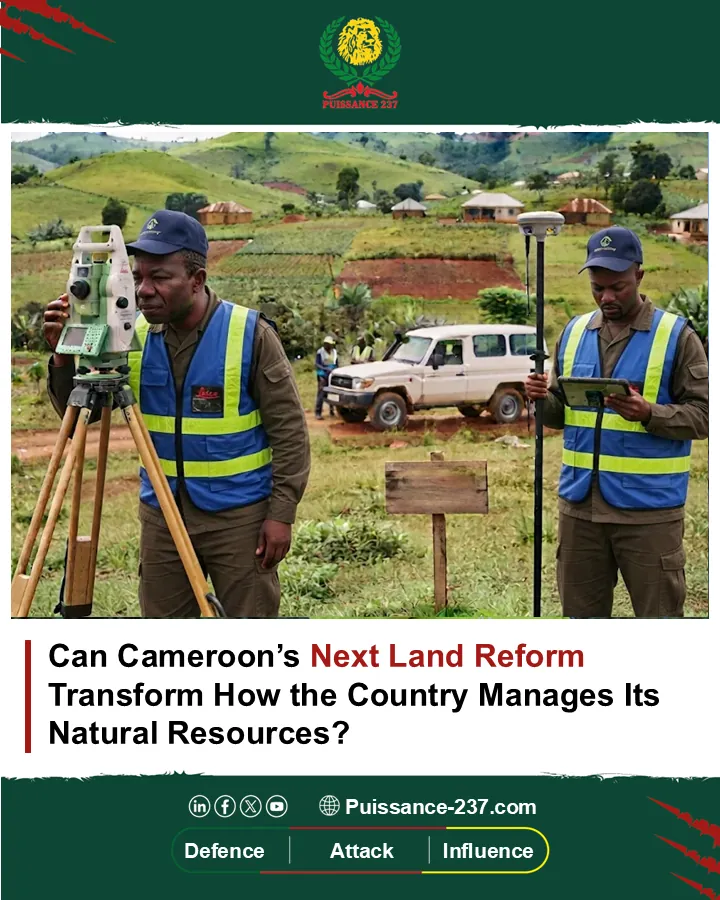
An inadequately understood territory is a resource that is difficult to protect. Amid land disputes, economic competition and uncertainty over land tenure rights, Cameroon faces a challenge that could shape its territorial future. As the country prepares a reform of its land governance framework, how can it turn effective land management into a genuine source of national power?
Land Governance: A Matter of National Power
On 11 November 2026, the United Kingdom and the National School of Local Administration (NASLA) announced a partnership aimed at improving the management of unregistered land and preventing land-related conflicts. Two regional workshops are planned in Buea and Bafoussam, bringing together the relevant government institutions. This initiative comes as Cameroon prepares a new national land policy and a review of its legal framework.
The national assessment highlights several challenges, including institutional fragmentation, weaknesses in the land registry system, gaps between certain legal provisions and customary practices, and a growing number of land disputes. These shortcomings go beyond administrative obstacles. They affect the country’s ability to plan agricultural activities, secure investments, protect community rights and prevent territorial tensions. Land has therefore become a space where competing economic, social and political interests converge, requiring a strategic approach.
Turning Territorial Knowledge into a Decision-Making Tool
In Power 237, Dr Guy Gweth places considerable emphasis on statistics as one of the foundations of national power. This principle has a direct application to land governance: a state that lacks sufficient knowledge of its territory will struggle to organise its resources and defend its interests. Cameroon should therefore move beyond a land registry system focused primarily on recording property ownership and develop a comprehensive national territorial intelligence system.
In practical terms, this would involve bringing together land, demographic, agricultural, economic and environmental data within a decision-support platform. Such a system would help identify areas under land pressure, strategically important agricultural zones, territories exposed to conflict, available resources and future land-use planning requirements. The information should be regularly updated and made available to relevant government institutions, local authorities and planning bodies. This approach would equip decision-makers with the tools to anticipate tensions, guide land allocation more effectively and prevent decisions that could undermine collective interests.
This knowledge should also serve to protect the country’s economic interests. Before approving major land transactions or allocations, the authorities should be able to assess the resources involved, existing activities, potential impacts on communities and expected economic returns. This would make it easier to evaluate investors’ commitments, prevent speculative transactions and negotiate terms that better serve the national economy. The strategic recommendation is clear: Cameroon must understand the value of its land before deciding how it should be allocated.
Mobilising National Stakeholders Around a Shared Territorial Vision
Knowledge alone is not enough if the institutions and stakeholders concerned continue to operate in silos. In Power 237, collective intelligence is presented as another foundation of national power. Applied to land governance, this principle calls for better information-sharing and stronger coordination among government institutions, local authorities, traditional leaders, researchers, businesses and communities.
Cameroon should therefore strengthen permanent territorial consultation mechanisms. Traditional authorities, who possess valuable historical knowledge of land use and occupation, should be more closely involved in documenting customary rights and preventing disputes. Local authorities could contribute to updating local information, while universities and research centres could provide demographic, economic and environmental analysis. Businesses, in turn, should have access to reliable land information to secure their projects within a transparent framework.
This approach should also include preventive mediation mechanisms. Rather than waiting for disputes to escalate, institutions should identify areas where demographic pressure, agricultural activities, pastoral movements and investment projects could generate tensions. Local dialogue mechanisms, supported by verified information, would help reconcile competing interests and develop solutions suited to the realities of each territory. Collective intelligence would thus become an instrument of stability and national interest protection.
Anticipating Territorial Changes to Prepare Cameroon for 2050
Demographic dynamics are another decisive factor. Population growth, urbanisation, food requirements, internal displacement and the expansion of economic activities will place increasing pressure on land. An effective land policy cannot therefore focus solely on resolving existing disputes. It must anticipate future needs and incorporate these changes into national planning.
In this regard, Cameroon should develop a territorial strategic monitoring system capable of tracking changes in land use, major transactions, pressure on resources and demographic trends. The resulting data would make it possible to develop different land-use scenarios and identify territories requiring priority attention and policy decisions. The objective would be to move away from a reactive approach to land disputes towards a genuine national capacity for anticipation.
The vision advanced in Power 237 takes on its full significance here. Power does not lie solely in the possession of resources, but also in the ability to understand them, organise them, protect the interests associated with them and mobilise the skills required to create value. By 2050, Cameroon must be able to turn effective land governance into an economic advantage, a source of social cohesion and an instrument of sovereignty. The ongoing reform provides an opportunity to lay the foundations for this ambition. The real challenge will be to build a system in which territorial decisions are based on reliable information, effective institutional coordination and a long-term strategic vision.
The Editorial Staff