
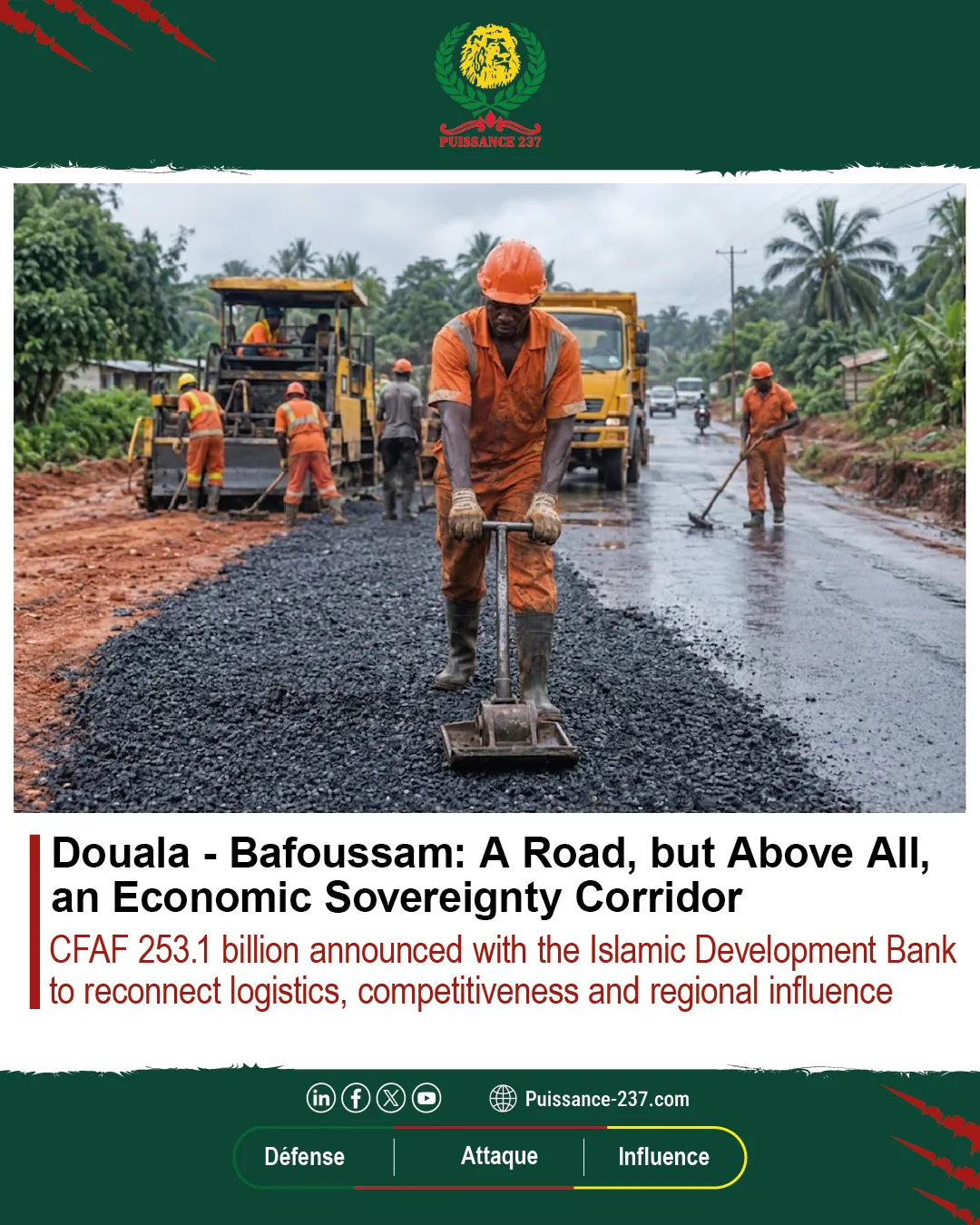
The prospective agreements between Cameroon and the Islamic Development Bank (IDB) could mobilize 253.1 billion FCFA for structuring projects. Among them, the rehabilitation of this 218.9 km corridor, estimated at around 139.3 billion FCFA, offers a concrete illustration of a recommendation made by Dr. Guy GWETH in Power 237: turning infrastructure into a lever for economic defense, commercial conquest, and regional influence.
An Economy Running at Half Speed
Between the port of Douala and the agricultural, industrial, and commercial basins of the West, every slowdown translates into added cost. Trucks take longer to deliver, vehicles wear out faster, fuel and repair expenses climb, and delays ripple through supply chains.
The effects spread across the entire economy. Manufacturers wait on their inputs, traders absorb higher logistics costs, farmers struggle to move their produce, and households end up bearing part of the extra costs through higher prices. On this corridor, the state of the road always ends up showing up somewhere: in delivery times, in business competitiveness, and in the consumer’s shopping basket.
Defending the Economy Through Its Flows
In Power 237, Dr. Guy GWETH points out that defense isn’t limited to protecting territory. It also covers a state’s ability to safeguard the material conditions of its autonomy: to produce, transport, supply, and distribute without being chronically hostage to failing infrastructure.
A reliable link between Douala and Bafoussam reduces businesses’ exposure to delays, supply disruptions, and unpredictable costs. It eases the movement of fertilizer, raw materials, equipment, and consumer goods. It also secures the access of agricultural and industrial output to markets. In this sense, the road becomes a piece of economic defense infrastructure.
Conquering Through Competitiveness
The same infrastructure can also play an offensive economic role. A Cameroonian company doesn’t win a market on product quality alone; it has to meet deadlines, honor its commitments, and control its costs. Seen this way, smoother movement between the port of Douala, production zones, and the markets of the West can strengthen the position of local producers, processors, and distributors.
The corridor should let agricultural products reach processing units faster, get manufactured goods to consumers more quickly, and help businesses connect their operations more effectively to national and sub-regional trade. Road performance then becomes a real factor in the commercial battle.
Extending Influence Beyond Borders
Influence is the third dimension at play. Thanks to its coastline and the role of the port of Douala, Cameroon holds a central position in Central African trade. But that position can only deliver its full potential if internal corridors effectively connect the port, the production basins, and the markets.
A road that is rebuilt, well maintained, and secure can help make the territory more attractive to investors, transporters, and regional partners. But asphalt alone isn’t enough. Maintenance, road safety, overload control, storage facilities, logistics services, and the establishment of processing activities will ultimately determine the corridor’s real strategic value.
A Vision Still to Be Realized
The news around the Douala – Bafoussam road confirms one of Power 237’s central recommendations: infrastructure should be designed as an instrument of power, not merely as equipment. The challenge, then, won’t just be mobilizing the announced 139.3 billion FCFA, but turning that investment into a lasting advantage for Cameroon’s production, trade, and regional standing.
The Editorial Staff