
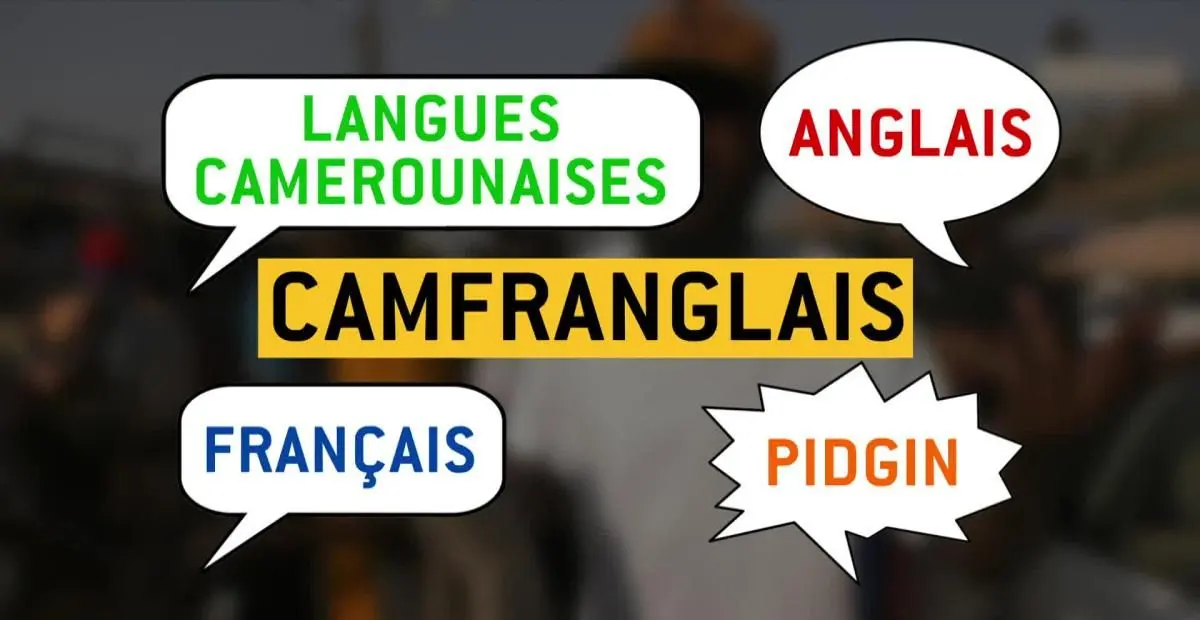
As Cameroon prepares to assert itself as a strategic leader on the African continent by 2050, as envisioned in Power 237 by Dr. Guy Gweth, language emerges as a subtle yet potent lever of national power. Among urban youth, Camfranglais — a hybrid blend of Cameroonian French, English, Pidgin, and indigenous languages — functions not merely as a means of communication but as a tool for social cohesion, identity formation, and cultural influence.
Chapter 26 of Power 237 highlights the strategic role of culture in national power, and Camfranglais exemplifies this principle by transforming linguistic diversity into a resource that strengthens Cameroon’s social fabric.
Camfranglais first appeared in the mid-1970s after the reunification of French and British Cameroon, gaining prominence in markets, schools, sports arenas, and urban streets. Its adoption accelerated in the late 1990s through the rise of urban Cameroonian artists who performed in the vernacular. Music, literature, and social media have since amplified its reach, projecting a modern, urban Cameroonian identity both domestically and internationally. As Chapter 14 emphasizes, Cameroon’s bilingual and multicultural character can be leveraged strategically, and Camfranglais embodies this asset by enabling seamless communication across Anglophone, Francophone, and indigenous linguistic communities.
Comparatively, Nigerian Pidgin English illustrates the soft power potential of urban vernaculars. Words such as wahala (trouble), Oga (boss), pikin (child), abi (right?), and jollof (staple dish) have traveled globally through music, movies, and diaspora networks, enhancing Nigeria’s cultural influence and even entering the Oxford English Dictionary. Camfranglais, while largely local, similarly reflects creativity, identity, and cultural hybridity. Words like Tu go où? (“Where are you going?”), Je vais te see tomorrow (“I will see you tomorrow”), J’ai buy le wé ci au bateau (“I bought this at the market”), Il est sorti nayo nayo (“He went out very slowly”), and Le mbom ci est trop chiche (“This boy is stingy”) illustrate how Cameroonian speakers blend multiple linguistic sources to communicate efficiently and expressively.
Chapter 6 of Power 237 underscores the importance of collective intelligence and informational asymmetry in national power. Camfranglais fosters such asymmetries: its speakers navigate complex linguistic contexts, code-switch fluidly, and communicate in ways inaccessible to outsiders. Proficiency in Camfranglais positions individuals advantageously within urban networks, commerce, and creative industries, demonstrating how linguistic mastery can translate into social, cultural, and economic leverage.
Ultimately, Camfranglais is not merely a youth-driven cultural phenomenon; it constitutes an endogenous lever of power. By nurturing its use, Cameroon strengthens social cohesion, projects cultural influence, and cultivates a generation capable of operating strategically across domestic and international spheres. As Power 237 reminds readers, national power extends beyond economic or military strength to encompass culture, cognition, and identity. Camfranglais exemplifies this principle: a language born of necessity and creativity, now driving influence, unity, and Cameroon’s emerging prominence in Africa.
Sharon Emade, Power 237