Isabelle Patchong Woundi: From Port Cranes to Networks, Engineering Shaping African Logistics Performance
9 October 2026
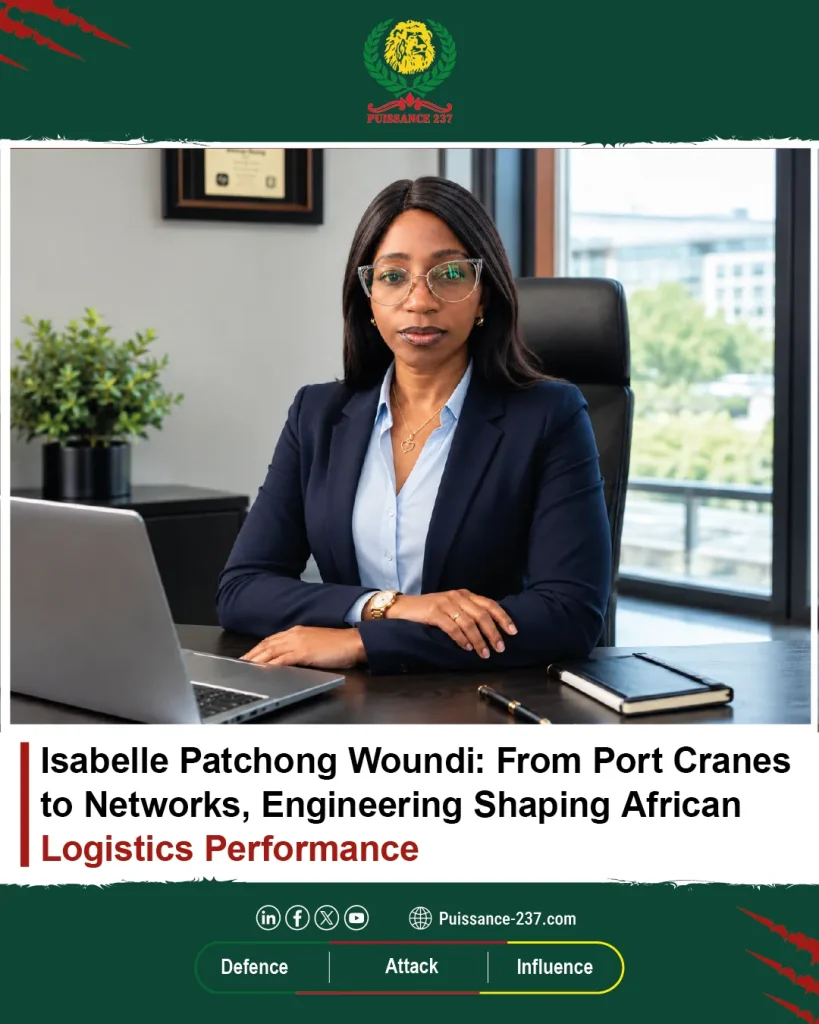
A port, a railway network or a logistics platform derives its economic value from more than the investment behind it. Its performance depends on the ability to maintain equipment, coordinate operations, ensure system reliability and keep information moving between the different stakeholders involved. Isabelle Patchong Woundi’s career, spanning industrial maintenance, port operations, railways and logistics, offers a field-level perspective on this reality: behind the infrastructure that moves goods are professionals whose expertise determines how reliably these systems operate, how efficiently they perform and how well their different components work together.
Infrastructure Performance Is About More Than Equipment
Isabelle Patchong Woundi’s research on container terminals in the Gulf of Guinea provides a first insight into this relationship. Her study links the commercial attractiveness of container terminals to three factors: equipment optimisation, human resource development and improved working methods. Its findings confirmed all three research hypotheses.
The conclusion may appear technical, but its implications are economic. A better-equipped terminal is not necessarily a more competitive one. Equipment availability, the quality of maintenance interventions, team organisation, truck turnaround times and operational discipline all affect the time gained or lost along the logistics chain. Infrastructure competitiveness is therefore shaped at the point where physical capital meets human capital and operational organisation.
Douala Had Already Raised the Question of System Connectivity
In 2019, Isabelle Patchong Woundi also examined the challenges of IT interconnection at the Port of Douala. Her research highlighted the dependence of import and export operations on systems that can communicate with one another, remain compatible and be accessible to the various stakeholders involved. She also considered the possibility of a single platform designed jointly by the different actors to simplify the movement of goods into and out of the port.
That question now extends well beyond the port itself. African trade chains depend on a succession of interfaces: ports, customs, inland transport, warehouses, payments, documentation, controls and final markets. Every break between these systems introduces additional cost, delay or risk. System interconnection therefore ceases to be merely an IT issue. It becomes a competitiveness issue.
Africa Is Beginning to Measure Its Ports Differently
Africa’s port sector is also moving towards a more data-driven understanding of performance. In March 2026, the African Development Bank brought together 104 port statisticians and maritime stakeholders representing 38 port authorities to harmonise performance indicators and advance the African Port Index. The initiative is designed to improve data comparability, strengthen data-driven decision-making and support better-performing, more investment-ready ports across the continent.
The implications are significant. Once port performance can be assessed against common benchmarks, differences become measurable: processing times, operational efficiency, service quality, connectivity and the ability to support economic corridors. Data is no longer used simply to report activity. It helps position an infrastructure within regional competition. What is measured can be compared; what is compared can inform decisions; and what informs decisions can be improved.
From the Machine to the System
Isabelle Patchong Woundi’s career takes on its full significance in this context. After training in industrial maintenance and beginning her professional journey as an apprentice mechanic at SDV Cameroon in 2004, she progressed through technical and managerial responsibilities within the logistics sector. She became Technical Director of Douala International Terminal in 2014, later worked at CAMRAIL, and now serves as Technical Director of Africa Global Logistics in Senegal. Her own account of her career describes the progression from apprentice mechanic in Cameroon to technical leadership in Senegal over 22 years.
The coherence of this trajectory lies less in the succession of job titles than in the gradual expansion of the field she has learned to master. Maintenance requires an understanding of machinery, its constraints and its failures. Technical management brings in asset availability, people management, safety and performance. Railways introduce the logic of networks. Logistics expands the equation further to flows, interfaces and continuity across an entire chain. As the scope widens, engineering itself changes: it is no longer only about keeping equipment operational, but about understanding the relationships that allow an entire system to function.
When Expertise Becomes Infrastructure
This is where human capital acquires a strategic dimension. Technical expertise gains value when it is tested against different equipment, demanding operational environments and increasingly complex responsibilities. When it moves across companies, sectors and African markets, it carries with it methods, professional experience, networks and an understanding of systems that can subsequently be applied elsewhere.
This accumulation is central to the perspective developed by Power 237. It makes it possible to view human capital as part of a country’s strategic infrastructure: less visible than a port or railway, yet essential to their operation and evolution. Isabelle Patchong Woundi’s career offers a concrete illustration. Dr Guy GWETH places the knowledge and mobilisation of a country’s resources at the heart of a broader reflection on Cameroon’s national power. Her trajectory shows, at its own scale, what such a resource can become when expertise developed in Cameroon is strengthened through experience across several systems and African markets.
The question therefore extends beyond an individual career: what advantage does a country gain from its engineers when they do more than occupy positions and learn to master the infrastructure, networks and flows on which its competitiveness depends? In an Africa increasingly expected to trade more intensively with itself, part of the answer lies in the ability to develop professionals capable of operating, connecting and continuously improving the systems that make this circulation possible.
The Editorial Staff